
Antarctica: Life on the Rocks
Episode 3 | 22m 8sVideo has Closed Captions
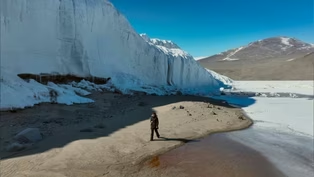
In a Mars-like region on Earth, hidden ecosystems persist despite extreme conditions.
In Beacon Valley, one of the most Mars-like regions on Earth, Ariel Waldman reveals hidden ecosystems that persist despite extreme conditions. From nematodes navigating salty permafrost to endoliths sheltering within sandstone and hypoliths thriving beneath translucent rocks, life endures in ingenious ways. Together, these discoveries offer insights into how life might survive on other planets.
Problems playing video? | Closed Captioning Feedback
Problems playing video? | Closed Captioning Feedback
Antarctica: Life on the Rocks
Episode 3 | 22m 8sVideo has Closed Captions
In Beacon Valley, one of the most Mars-like regions on Earth, Ariel Waldman reveals hidden ecosystems that persist despite extreme conditions. From nematodes navigating salty permafrost to endoliths sheltering within sandstone and hypoliths thriving beneath translucent rocks, life endures in ingenious ways. Together, these discoveries offer insights into how life might survive on other planets.
Problems playing video? | Closed Captioning Feedback
How to Watch Life Unearthed with Ariel Waldman
Life Unearthed with Ariel Waldman is available to stream on pbs.org and the free PBS App, available on iPhone, Apple TV, Android TV, Android smartphones, Amazon Fire TV, Amazon Fire Tablet, Roku, Samsung Smart TV, LG TV, and Vizio.
Providing Support for PBS.org
Learn Moreabout PBS online sponsorship[mellow string music] Antarctica.
It's a vast land that's unlike anywhere else we know.
From the depths of its frozen lakes to the towering peaks of its spectacular mountains, it's a place of unparalleled wonder and hidden mysteries.
I want to tell the story of a continent that's waiting to be seen.
To truly see this world, though, you need to view it from a different perspective.
From the dizzying heights of an orbiting spacecraft all the way down through the lens of a microscope.
I'm on an expedition in Antarctica to uncover the extreme environments that host the smallest animals on the planet.
As a researcher, for two months, I'll be hiking glaciers, traversing frozen landscapes, flying above mountains, and camping in one of the most otherworldly places on planet Earth.
And if that wasn't enough to keep my hands full, I wanted to see if I could film it all by myself, using a suite of cameras, drones, and microscopes to reveal the unusual nature of a unique area of Antarctica.
It's interesting to think about how the most Mars-like place in Antarctica might actually be the key to unlocking how life can get a foothold elsewhere, and what that says about how life might take place on other planets and moons.
Welcome to an extraordinary journey to an unlikely oasis at the edge of our world.
[lonely guitar music] In the harshest realms of our planet, where temperatures plummet and water is a rare luxury, life has a remarkable story of survival to tell.
But it's not so easy to find.
[helicopter in flight] Today, I'm taking a helicopter into the high altitudes of this extreme environment to uncover the creatures that are especially good at hiding from the elements.
Flying into this location feels like traveling to another world.
Along the way, we cross over sweeping monuments of ice until eventually what few glaciers freckle the area begin to disappear from view.
Looking down, an interesting pattern emerges from the red, rocky terrain.
A series of polygonal cracks reaches out across the expanse.
I've seen them before in other corners of the Dry Valleys.
Thought to be thousands of years old, they're stress fractures formed by ancient ice buried deep below a blanket of dry permafrost.
Dry permafrost is unique to Antarctica.
Found nowhere else on Earth so far, the only other place we've found it on is Mars.
From this vantage point, it's easy to see the stark contrast between the edge of the continent's massive ice sheet and where I'm about to land.
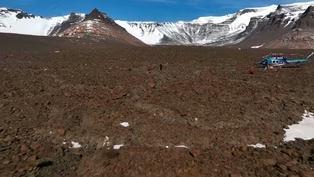
I'm here at one of the most Mars-like places you can be on planet Earth.
This is Beacon Valley.
Beacon Valley is one of the more striking valleys of the Dry Valleys because of what's not here.
There's no frozen lakes, there's no glaciers.
It's a massive rocky field.
In fact, it was really difficult for our helicopter pilot to land here because of all the boulders that are around.
[inspirational ambient music] It's nice to come here and contemplate what it would be like to be the first astronaut on Mars, and how that would feel.
if it feels something like this, it's pretty cool.
[lonely guitar chord] As fascinating as this location looks above ground, it's what's under these rocks that brought me here.
For decades, it has been believed that nothing lives in Beacon Valley beyond relatively simple forms of life, like bacteria, due to the harsh and salty nature of the environment here.
But our team has just made an exciting new discovery.
Burrowed in the permafrost, a unique animal has found a way to survive in this environment.
[inspiring minimal synth music] So we're out here today with the Soils team on the McMurdo Dry Valleys Long Term Ecological Research group.
The Soils team has actually been able to detect some nematodes that are surviving out here, which is incredibly exciting.
To think about all of this types of life that can live in this Mars-like environment says so much about what we are learning about how life can survive here on Earth, but also about the limits of where life can survive in outer space.
On other planets and moons, places that we might think are not very habitable, might in fact be inhabited.
Amongst the rocky terrain, the team found a few small Goldilocks spots, places where a rock absorbs just enough sunlight to heat a tiny patch of ice into liquid water.
This creates a suitable habitat for a very special kind of nematode.
Remarkable for its ability to not only tolerate, but prefer dry and salty environments, the Scottnema is notable for being endemic to Antarctica.
Slithering through the thin channels of salty water that cling to the rocks, these tiny worms, no thicker than a strand of hair, are able to endure and even thrive in this subzero maze.
Their secret?
A natural antifreeze running through their bodies, preventing ice and desiccation from claiming their fragile forms.
To some, all worms look the same, but to the Soils team affectionately known as the Wormherders, Scottnema can easily be identified by their spiky lips and thick, pointy tail.
Unlike the nematodes in other parts of Antarctica, Scottnema don't clone themselves.
Instead, they need to find a mate in these harsh conditions, which makes their story of survival here all the more impressive.
[uplifting orchestral music] Higher up in the mountains surrounding Beacon Valley, a different scene of life unfolds.
Looking around, you don't obviously see any signs of life.
You don't see any green, any plants or anything like that.
But high up in the mountains behind me, there exists a layer of sandstone from a Jurassic beach that got compressed over time, and in that sandstone, are living microorganisms that call that place their home.
Within the crumbling rocks of this ancient beach exist entire hidden worlds.
Tiny creatures have found an ingenious way to combat the frigid, deathly cold.
They've turned these stone fortresses into sanctuaries, proving that even in the bleakest of landscapes, the pulse of life persists.
These little creatures that live inside the sandstone are in there because they're taking shelter from this harsh environment inside of the sandstone, it's a warmer, wetter environment, just barely, just barely enough for them to survive.
And importantly, sun can penetrate through some layers of the sandstone, allowing them to still photosynthesize.
So we're going to start looking inside some of these sandstones to see if we can find these little micro-organisms, known as endoliths.
After a few tries, we were able to find the telltale signs of these microscopic communities.
As they settle into the sandstone, they dissolve the orange iron through releasing acid, slowly bleaching out portions of the rock to white before moving elsewhere.
These rocks were once inhabited by lichen, algae, and bacteria before they tumbled to the valley floor.
Safely situated high up in the mountain ridges, the interior layers of sandstone instead show bands of black and green, marking the contemporary homes of endoliths.
By using the sandstone as shelter, they're able to survive not only the cold, but also the wind, dryness and UV radiation that permeate the area.
What's so captivating about endoliths is not only their ability to live inside of rocks, which is just really cool, but it's also their ability to be primary producers.
They're the start of the food chain.
So they're able to take basic materials like sunlight and use that to turn it into food.
Without primary producers, we wouldn't have other creatures here on Earth.
We need the start of the food chain to have everything else.
And so it's thought that even though these endoliths are high up in the mountains and surviving just barely, that they're actually a really intrinsic part of life here in the Dry Valleys.
Because without the start of the food chain, we can't have the rest of it.
[calm orchestral music] In a different part of the Dry Valleys, where conditions are less harsh, large patches of snow help supply water in the summer months.
If you remain still and look closely in this environment, you can just barely spot tiny creatures crawling around the rocks with your naked eye.
This little friend has come out to enjoy the summer sunlight.
It's not an ant, nor even technically an insect.
This is a springtail, so named for its ability to jump like a spring.
But these springtails, who have been isolated in Antarctica for millions of years, have lost their ability to jump.
Instead, they crawl around, surviving off of algae and lichen in the summer and produce antifreeze molecules in their bodies to endure the long, cold winters in a state of suspended animation.
At one to three millimeters in size, they are the largest animal of the Dry Valleys that live there year round.
Lurking under rocks near a pond of melted snow, a creature with a similar story of survival can be found.
An Antarctic mite.
At well under a millimeter in size, its small stature and quick speed require careful concentration to find.
Like the springtail, mites feed primarily on algae and lichen, and are able to power down over the long, dark winter.
They prefer the underside of rocks that are able to retain just enough moisture to make their home a more comfortable oasis.
I've hiked over to a different part of the Dry Valleys to find another type of life that lives underneath rocks.
Though it doesn't scurry around, it's still pretty tricky to spot.
To find it takes a keen eye.
It won't live under just any rock.
This life form explicitly seeks out small, pale stones to make its home.
So I've gone on a bit of an Easter egg hunt to find it.
[funny plucking string music] No.
Nope.
Nope.
Try again.
No.
No.
Definitely not.
Nope.
Finally, after several more unsuccessful attempts, I found it: a hypolith!
Consisting of a green film of photosynthetic bacteria, you might wonder why these communities prefer to live under rocks seemingly away from the sun.
They require the protection of rocks to shelter them from the harsh wind and UV radiation that would otherwise zap away any moisture.
But cleverly, they seek out small rocks that are semi-translucent, allowing just enough sunlight to penetrate through the rock for them to survive.
In a sense, they've found a way to build their own greenhouses in a polar desert.
In a landscape defined by its extremes, these hidden moisture pockets become hubs of biological activity, reminding us that life, given even the slimmest chance, will find a way to flourish.
[uplifting orchestral music] Our journey through one of the most inhospitable yet strikingly beautiful places on Earth has shown us how much more there is to learn about our own home.
The Dry Valleys of Antarctica offer us a rare glimpse into the outermost reaches of our planet.
Their quiet majesty has stood for millions of years, closely guarding secrets to life on our planet that we are only just beginning to understand.
It's in this harsh landscape, where the wind sculpts ice and stone alike, that life has found extraordinarily clever ways to prevail.
The microscopic animals and organisms in Antarctica have perfected the art of survival.
Our careful examination of them has revealed that they do not merely survive; they thrive, contributing to the complex tapestry of life on Earth.
And yet, it is here that life has adapted to an environment as close to Mars as can be found on our own planet.
Offering a humbling glimpse into life's capacity to survive elsewhere in the cosmos.
The weather in Antarctica is really unlike anything in the world.
It's around the summer solstice right now, and we've had, you know, some sun, which has been nice.
Temperatures have been around freezing, which is really nice, uh, for Antarctica in the summer.
But today it feels like Antarctica.
It is windy.
It is cold.
It is really cold.
I'm really cold.
What initially drew me to this incredibly cold and windy place, is how much it's like being able to go to space without becoming an astronaut.
It's a place that's unlike anywhere else on Earth, and it's a place really where you can learn so much, not only about yourself, but about the planet you call home.
[fast-paced uplifting orchestral music] Through our exploration of Antarctica, we've discovered strange new worlds, walked on alien landscapes and unearthed the smallest animals on the planet.
These tiny organisms may hold answers to some of the biggest questions we have about the potential for life beyond our world.
[music concludes] Antarctica provides both a hopeful story and a cautionary tale about finding life elsewhere in the cosmos.
On one hand, we've found life in such extreme environments here where no one thought anything would be living.
And that's incredibly exciting when thinking about finding life on other planets and moons in our solar system and beyond.
But there's other environments here that people have hoped to find life, only to come up short.
And those environments tell us that there are still limits to where life can survive.
And that provides a cautionary tale about thinking that we might find life everywhere we look.
Life might be rare.
But even with all the planets and moons and our galaxy and beyond, it's still incredibly exciting, because even if life is rare and has extremes where it can't survive, there's just so much out there that even the rarity of life means there must be a whole ton of it in the universe.
[whimsical orchestral music] As the end of my two month expedition nears, I'm left in awe of the tenacity of life in this polar desert.
Microscopic yet mighty, the organisms that thrive in the heart of Antarctica's harsh environments are a testament to the resilience of life.
More than anything, Antarctica teaches us about the corners of our own home planet that we never knew before.
We just needed to see it through a different lens.
[thoughtful string music] But let us not forget that this frozen library of wonder is one that is under our guardianship.
Our protection of Antarctica is not only an act of conservation, it is an act of preserving the legacy of Earth's enduring marvels and the boundless potential of life in all its forms.
[reflective piano music]
Video has Closed Captions
Preview: Ep3 | 30s | In a Mars-like region on Earth, hidden ecosystems persist despite extreme conditions. (30s)
Video has Closed Captions
Clip: Ep3 | 2m 36s | Explorer Ariel Waldman experiences the most Mars-like place on Earth: the Dry Valleys. (2m 36s)
Providing Support for PBS.org
Learn Moreabout PBS online sponsorship
- Science and Nature

Explore scientific discoveries on television's most acclaimed science documentary series.
- Science and Nature

A stunning global series that shows how sharing space with wildlife benefits people.










Support for PBS provided by: