
April 17, 2026 - PBS News Hour full episode
4/17/2026 | 57m 46sVideo has Closed Captions
April 17, 2026 - PBS News Hour full episode
Friday on the News Hour, the ceasefire holds in Lebanon, but questions remain about the future of the wider war as Iran claims it has reopened the Strait of Hormuz. Americans' overall health faces an uncertain future as the cost of care rises. Plus, a former Kennedy Center staffer speaks out about what he calls the chaos and cronyism at the institution after President Trump took control.
Problems playing video? | Closed Captioning Feedback
Problems playing video? | Closed Captioning Feedback
Major corporate funding for the PBS News Hour is provided by BDO, BNSF, Consumer Cellular, American Cruise Lines, and Raymond James. Funding for the PBS NewsHour Weekend is provided by...
April 17, 2026 - PBS News Hour full episode
4/17/2026 | 57m 46sVideo has Closed Captions
Friday on the News Hour, the ceasefire holds in Lebanon, but questions remain about the future of the wider war as Iran claims it has reopened the Strait of Hormuz. Americans' overall health faces an uncertain future as the cost of care rises. Plus, a former Kennedy Center staffer speaks out about what he calls the chaos and cronyism at the institution after President Trump took control.
Problems playing video? | Closed Captioning Feedback
How to Watch PBS News Hour
PBS News Hour is available to stream on pbs.org and the free PBS App, available on iPhone, Apple TV, Android TV, Android smartphones, Amazon Fire TV, Amazon Fire Tablet, Roku, Samsung Smart TV, LG TV, and Vizio.
Providing Support for PBS.org
Learn Moreabout PBS online sponsorshipAMNA NAWAZ: Good evening.
I'm Amna Nawaz.
GEOFF BENNETT: And I'm Geoff Bennett.
On the "News Hour" tonight: The cease-fire holds in Lebanon, but questions remain about the future of the wider war, as Iran claims it has reopened the Strait of Hormuz.
AMNA NAWAZ: Americans overall health faces an uncertain future, as the cost of care rises after Congress let some government subsidies expire.
GEOFF BENNETT: And a former Kennedy Center staffer speaks out about what he calls the chaos and cronyism at the institution after President Trump took control.
JOSEF PALERMO, Former Visual Arts Curator, Kennedy Center: We are grafting political management strategies onto a nonpolitical organization.
(BREAK) GEOFF BENNETT: Welcome to the "News Hour."
Iran said today it has reopened the Strait of Hormuz to commercial shipping, a move President Trump quickly welcomed on social media.
But even as traffic resumes, the president says the U.S.
naval blockade of Iranian ports will remain in place.
AMNA NAWAZ: But Iranian officials also said ships must follow designated restricted routes and in some cases must coordinate transit with Iran.
In the meantime, there are new disagreements and competing claims over Iran's nuclear program days before a cease-fire between the U.S.
and Iran is set to expire.
And, in Lebanon, the day-old truce between Israel and Hezbollah appeared to hold after weeks of intense fighting.
Special correspondent Simona Foltyn begins our coverage.
SIMONA FOLTYN: Tonight, both the U.S.
and Iran claim that the Strait of Hormuz is completely open once again.
President Trump and Iran's foreign minister, Abbas Araghchi, announced that full passage of commercial ship traffic would resume through the critical waterway, through which a fifth of the world's oil flows.
(BELL RINGING) SIMONA FOLTYN: Across the world, markets rejoiced and crude prices plummeted on the news.
Iran said the reopening would last for the duration of the 10-day cease-fire in Lebanon.
But there are still disputes.
President Trump said that the U.S.
naval blockade of the strait would remain in full force until Iran reached a sweeping deal with the U.S.
QUESTION: There's been reporting today that there's still -- Iran says there are significant differences.
DONALD TRUMP, President of the United States: Well, there could be.
Let's see what happens.
If there are, we will have to straighten it out, but I don't think there's too many significant differences.
QUESTION: What will it take to end the blockade?
DONALD TRUMP: When the agreement is signed, the blockade ends.
As soon as the agreement gets signed, that's when the blockade ends.
SIMONA FOLTYN: For the president, that means Iran would give up its highly enriched uranium, what Trump calls nuclear dust.
With such delicate diplomacy at stake, Mr.
Trump also warned Israel not to return to fighting.
"Israel will not be bombing Lebanon any longer.
They are prohibited from doing so by the USA.
Enough is enough."
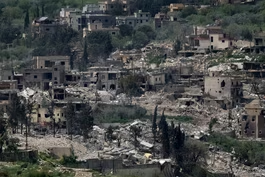
The cease-fire announcement sparked cautious celebration in Lebanon last night.
People poured into the streets, relieved for a moment, at least, to get a respite from Israeli attacks that have killed more than 2,000 people.
For hours, cars clogged roads leading south as many of the displaced returned.
Mohammed and his wife, Nadia, couldn't wait to get back home with four-month-old Adam, who survived his first war.
MOHAMMED ABDALLA, Resident of Saksakiyeh, Lebanon (through translator): If I die tomorrow, I want to be buried on my land.
We have suffered a lot during this war.
To leave one's home behind is very painful.
NADIA AL KHATIB, Resident of Saksakiyeh, Lebanon (through translator): Maybe we will be scared if we hear some sounds of war, but we don't have a choice.
We want to go back to our land.
SIMONA FOLTYN: When they fled the bombing, there was fear they'd never be allowed to go back, as Israeli troops pushed north in the bids to occupy Southern Lebanon.
These cars are full of displaced families heading home.
You can see some of the cars have mattresses and other belongings strapped to the roofs.
And this is in spite of warnings by both the Israeli and the Lebanese government to stay away from areas south of the Litani, where the IDF continues to operate.
But people are anxious to get home.
They want to check on their houses to see if they still stand after weeks of heavy bombardment in what is also a message of defiance that they will not be forced from their land.
The cease-fire before this one, agreed in 2024, failed to end the war.
Israel violated the agreement on a near daily basis, bombing villages in the south, even as Hezbollah held its fire.
So, you're going back now.
Are you confident that the cease-fire will hold?
ALI MOQTAD, Resident of Nabatieh, Lebanon: Not that confident, but the thing is, like, we don't have any other option.
Our land, our home, our families, the neighborhood, everyone is going up.
Like, this time, it's not only about Lebanon.
It's like in the region, like, between Iran, USA, Hormuz.
SIMONA FOLTYN: So you think that helps?
ALI MOQTAD: Yes, and like, if -- like, in the region, if it stayed like that, and Lebanon will -- by default, the cease-fire will continue in Lebanon.
SIMONA FOLTYN: Not everyone is convinced that this regional war is about to end.
And after six weeks of intense fighting here in Lebanon, 10 days of pause don't seem like much.
And even those will be filled with uncertainty whether ongoing talks will usher in lasting truce.
These displaced families camping out on Beirut's waterfront have chosen to wait and see.
HUSSAIN MUNZIR, Displaced From Burj el-Barajneh, Lebanon (through translator): We want to finish with this war and go home.
But these 10 days are for what?
What are we supposed to do with 10 days?
We go and, if there's a new war, we're displaced again?
SIMONA FOLTYN: Hussain's home in Beirut's southern suburbs is gone.
It's one of more than 37,000 housing units destroyed in Israeli attacks.
HUSSAIN MUNZIR (through translator): Our house is no more.
Where would we live?
We will stay here.
We will see what happens during these 10 days.
If it goes well, we will go back and rent an apartment.
What else can we do?
SIMONA FOLTYN: People here don't trust that a Trump administration can push Israel to abide by the cease-fire.
HUSSAIN MUNZIR (through translator): They always say they want a cease-fire, but they hit us again.
That's why we're afraid to go back.
We have children.
They're all liars without honor.
They want to take our land and destroy everything.
SIMONA FOLTYN: Israel insists that Hezbollah must be completely disarmed, but many Lebanese feel that Israel's invasion was more about taking Lebanese land than Hezbollah's weapons.
And Israel made it clear today that it has no intention of ever leaving.
ISRAEL KATZ, Israeli Defense Minister (through translator): The Israeli Army holds and will continue to hold all the places it has cleared and conquered.
The ground maneuver into Lebanon and the attacks on Hezbollah all over Lebanon have achieved many achievements, but have not yet been completed.
SIMONA FOLTYN: It's such words and actions that are reinforcing Hezbollah's popularity among Lebanon's Shia.
Many believe that nobody else will try to stop Israel from annexing their lands to become part of greater Israel, a biblical concept often invoked by Israeli government officials.
MOHAMMAD AWAD, Displaced from Beirut Suburbs (through translator): They want greater Israel from the river to the sea.
They will not withdraw unless it's through force, through resistance.
We want resistance.
We don't want anything else.
Israel won't leave otherwise.
If I could, I would go fight in the south.
SIMONA FOLTYN: Many of Hezbollah's supporters reject the government's decision to enter into direct talks with Israel at a time when the IDF still occupies part of the country.
MOHAMMAD AWAD (through translator): We reject it, of course.
This is not negotiation, but capitulation.
Israel doesn't abide by agreements or negotiations.
SIMONA FOLTYN: And that Israeli insistence on Hezbollah disarmament remains a controversial and sensitive subject in Lebanon, one that could ignite internal strife with not one, but two cease-fires hanging in the balance.
For the "PBS News Hour," I'm Simona Foltyn in Beirut.
AMNA NAWAZ: For more now on the status of the Strait of Hormuz and if it's really open to all ships, we turn to Ian Ralby.
He's president of Auxilium Worldwide.
That's a nonprofit organization that focuses on ocean governance and maritime law and security.
Ian, welcome back to the "News Hour."
Let's just start with what we heard from both Iranian and U.S.
officials.
They're saying the Strait of Hormuz is open.
What are you seeing and hearing?
Is it really open to all commercial traffic?
IAN RALBY, President, Auxilium Worldwide: Well, I think we keep hearing that, but it means something very different in practice than what most of us would want.
Completely open would suggest that there would be free flow of maritime commerce, uninhibited, unimpeded.
That is not what is happening at the moment.
Iran's own conditions on the opening were that the vessels that wanted to come through would have to get permission from the IRGC and follow their own prescribed transit routes, which route vessels around Larak Island, near to the Iranian coast.
And so this is not a free and open Strait of Hormuz the way most of us would want it to be.
It is very much still within the control of Iran.
And what we have seen today is a complete difference between the rhetoric and the reality.
The vessels that tried to get through and started moving towards the strait and seemed to be on their way to passing through for the first time in weeks and months were actually hailed and turned back for lack of permission from Iran.
And so the rhetoric and the reality are very different at the moment.
And I think we have to be very careful not to get overly excited by what we're hearing from either Tehran or Washington.
AMNA NAWAZ: I just want to make real for people what you described there.
We have a map I want to show folks showing those traffic routes and transit routes.
In yellow there is the route that was open to all commercial vessels before the war began.
That blue route you see, the more narrow, restricted route as you described it, Ian, is the current route, the designated, coordinated route that Iranian officials have set up.
And, as you say, ships are being turned back.
But what are you hearing from the shipping companies themselves about how they're looking at this moment?
As soon as they heard the strait was open, did many of them indeed try to just pick back up where they left off and transit the strait?
IAN RALBY: Well, I think many are wisely cautious to believe anything coming out of Iran, especially after the amount of attacks that have occurred on vessels over the last month-and-a-half.
But, equally, we have to be careful about what we believe out of Washington, because the rhetoric from the president has been both inconsistent and volatile at times.
And so what we're seeing today is a mismatch between what everybody is saying and what is actually happening.
And so shipping companies were momentarily optimistic and enthusiastic, but the reality is actually pushing in a different direction.
And I think that they had a moment of uncertainty and concern around what might actually happen, but were hopeful that a perhaps en masse movement would overcome any kind of immediate concern.
Unfortunately, it does not seem to be working out quite as hopefully as everyone had hoped.
And so I think that what we're going to see is a little bit more resistance and resilience on the part of the shipping industry to wait for a greater degree of clarity, which has yet to arrive.
AMNA NAWAZ: So, Ian, even if there was clarity on this, which we don't have now, clarity, say, tomorrow that the strait was truly and unconditionally reopened for traditional transit patterns, what would you expect to see?
How long would it take for normal traffic patterns and movement to pick up?
IAN RALBY: Well, we really have two problems.
We have Iran at the one hand trying to maintain a choke hold on this choke point, because, even though they want to say it's open and want to give the optics to suggest that they are now the rational party that's making headway towards normalcy, we also still have a degree to which they're going to want to control what they have managed to use as their greatest leverage.
And so it is unlikely they're going to want to give that up any time soon.
At the same time, the U.S.
blockade is still in place.
And so that means that any vessels that have an Iranian connection or go to Iranian ports, call in Iran in any way, are also subject to being either turned away or potentially seized.
And so the announcement from the U.S.
yesterday that they're going to start seizing Iranian-affiliated cargoes worldwide does not exactly engender the kind of optimism that this is going to be a free and open strait any time soon.
And so we are probably a ways away from where we'd see a resumption of normal traffic.
We also don't know what the security picture is in terms of mines or asymmetric capabilities which the Iranians may still yet want to deploy in the event that things break down on the negotiating table.
And so we're well away from a point where maritime commerce can breathe the sigh of relief and we can expect free flow of maritime commerce and thus a resumption of the oil and gas trade, as well as all the other trades, and including containers and bulkers and everything else that moves through, for food, for goods, for medicine.
So this is yet to get to the point of any kind of calm and comfort for the ship owners, as well as for the seafarers, the people who carry our goods on board.
It is still life or death for them to try to go through, and we have to keep that in mind.
AMNA NAWAZ: That is Ian Ralby, president of Auxilium Worldwide, joining us tonight.
Ian, thank you so much for your time.
IAN RALBY: Thank you.
GEOFF BENNETT: In the day's other headlines: Millions across the Midwest are closing out a brutal week of summerlike storms with even more extreme weather expected tonight and through the weekend.
A huge chunk of the country is facing the risk of severe storms stretching from the southern U.S.
border to the Great Lakes.
That includes Wisconsin, where at least one person has died amid what local forecasters are calling unprecedented weather this past week that includes seven confirmed tornadoes and more than 100 severe thunderstorm warnings.
Milwaukee set a new record for rain in April, and the month is barely halfway over.
The U.S.
Senate today approved a short-term renewal of a controversial surveillance program used by U.S.
spy agencies.
SEN.
KATIE BRITT (R-AL): All in favor, say aye.
MAN: Aye.
SEN.
KATIE BRITT: All opposed, no.
The ayes appear to have it.
The ayes do have it.
The bill is passed.
GEOFF BENNETT: The measure passed by what's known as a voice vote and extends a part of the Foreign Intelligence Surveillance Act, or FISA, until April 30.
That gives lawmakers more time for negotiations after an effort to renew the program for five years failed late last night in the House.
President Trump has pressured lawmakers for an 18-month extension.
FISA allows for the warrantless collection of foreign communications on U.S.
soil.
Officials argue it's key to stopping terrorism and espionage, but critics have raised privacy concerns.
In California, musician D4vd is being held without bail after his arrest yesterday in connection with the death of a missing teenage girl.
The 21-year-old star, whose real name is David Burke, has millions of followers on social media, and he created the anthem for the video game "Fortnite."
He's been the focus of speculation after the decomposed body of 14-year-old Celeste Rivas Hernandez was found in his car last year.
Her family had reported her missing back in 2024.
Police say Burke was arrested on suspicion of murder.
They will present their case to prosecutors on Monday.
His lawyers say he is innocent.
French officials say an 85-year-old widow of an American military veteran has returned home after being held in U.S.
immigration custody for more than two weeks.
Marie-Therese Ross' husband died unexpectedly after they were married last year, and she had overstayed her visa.
France's foreign minister announced her return earlier today, while also denouncing ICE's approach.
JEAN-NOEL BARROT, French Foreign Minister (through translator): These were not methods that were acceptable for us.
There was violence that concerned us, but the essential thing is that she is back in France, and we are completely satisfied.
GEOFF BENNETT: Her release comes a day after ICE Acting Director Todd Lyons said he will step down at the end of May.
During his tenure, Lyons played a key role in carrying out President Trump's immigration crackdown.
That included a number of high-profile enforcement actions, as well as the deaths of Americans Renee Good and Alex Pretti in Minneapolis.
His replacement has yet to be announced.
British Prime Minister Keir Starmer is rejecting calls to resign amid revelations that his former Ambassador to the U.S.
Peter Mandelson was appointed to the post despite failing security checks.
Speaking to reporters in Paris, Starmer said he was unaware of the lapse at the time and is, as he put it, absolutely furious.
Starmer fired Mandelson last year over his ties to the late sex offender Jeffrey Epstein.
Mr.
Starmer is expected to address Parliament about the issue on Monday.
In the business world, the parent company of QVC has filed for Chapter 11 bankruptcy protection.
QVC Group also runs HSN, formerly the Home Shopping Network.
The company has been struggling amid a surge in online shopping options and livestreaming apps like TikTok.
QVC says its brands will continue operating as usual as it undergoes restructuring.
Meantime, on Wall Street today, stocks shot higher as investors welcomed news about the Strait of Hormuz reopening.
The Dow Jones industrial average jumped more than 800 points on the day.
The Nasdaq added 365 points, or more than 1.5 percent.
The S&P 500 ended the week at a new all-time high.
And country music songwriter Don Schlitz has died.
His most famous song, "The Gambler," was recorded by Kenny Rogers back in 1978.
It went five-times platinum and was a crossover hit for both artists.
Schlitz went on to write some of the most enduring songs in country music for legends like Randy Travis and The Judds.
In 2012, he was inducted into the Songwriters Hall of Fame.
He's also in the Country music Hall of Fame.
The head of the Country Music Association said today: "His legacy lives on through his music and the many artists and writers he inspired."
Don Schlitz was 73 years old.
Still to come on the "News Hour": we look at how the Trump administration's recent actions are affecting support among young voters; David Brooks and Jonathan Capehart weigh in on the week's political headlines.
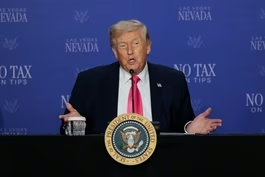
President Trump is on the road this week speaking tonight to young voters at a rally in Phoenix held by Turning Point USA.
At the top of his speech, the president spoke about the war with Iran.
DONALD TRUMP, President of the United States: This will be a great and brilliant day for the world, because Iran has just announced that the Strait of Hormuz is fully open and ready for business.
(CHEERING) GEOFF BENNETT: Joining us now is White House correspondent Liz Landers.
So, Liz, the president's remarks come at a time when polls show his standing slipping with younger voters.
What more did he say this evening?
LIZ LANDERS: Well, he has been talking about a range of issues.
I would say that he is still talking right now.
So I was listening to the speech as I was coming on set here.
He started talking about Iran at the top.
But he needs to focus on domestic issues in order to get these younger voters back.
There was a Yale Youth Poll that was conducted in March that looked at his disapproval, which is going up right now with younger voters.
For voters aged 18 to 22, his disapproval stands at 68 percent, for the age group 23 to 29 years old, 72 percent disapproval, and 30 to 34 years old 75 percent disapproval.
This was conducted in March.
But they did a similar survey between October and November of last year, and his approval between that survey and this one, the most recent one, dropped in every age group under the age of 35.
So all these young people are becoming less excited about him and less supportive of him as president.
In particular, the majority of young voters will vote for Democrats as of right now, according to that poll, in the fall.
And young women voters have in particular moved away from President Trump.
He saw -- Democrats saw a gain of 17 points for young women 18 to 22 years old, and the top issue, according to that Yale Youth Poll, was affordability.
GEOFF BENNETT: And the president, meantime, Liz, as you well know, he is keeping up this ongoing dispute with Pope Leo.
When you talk to folks at the White House, what are they saying about that?
LIZ LANDERS: This has been going on now for six days, and the president started this on Sunday of last week and continues to talk about it.
He was asked about this yesterday as he was leaving the White House to go to Las Vegas.
DONALD TRUMP: I have to do what's right.
The pope has to understand that.
Very simple.
I have nothing against the pope.
His brother is MAGA all the way.
I like his brother really.
QUESTION: So, why are you fighting with him?
DONALD TRUMP: I'm not fighting with him.
The pope made a statement.
He says Iran can have a nuclear weapon.
I say Iran cannot have a nuclear weapon.
LIZ LANDERS: Pope Leo, I should add, has not said that Iran can have a nuclear weapon, just so we're clear about that.
But this has now turned into something that the vice president, who is Catholic, has been asked about.
He was also at a Turning Point USA event earlier this week in Georgia and was heckled by someone in the crowd, who yelled out "Jesus Christ does not support genocide."
J.D.
Vance turned to him and said, yes, Jesus Christ did not support genocide.
But he went on to say that the pope needs to be careful when he talks about matters of theology, Geoff.
GEOFF BENNETT: Back to the president's travels.
He's out West.
He's talking about the economy.
He's talking about this tax cut package he signed.
He's clearly trying to pivot here away from the war with Iran to an economic message.
LIZ LANDERS: Well, the White House has made it clear that they know they have to talk about affordability, and that is what Republicans have to run on in order to try to do well in the November elections, where historically they probably won't do that well as the party in power.
We heard from the treasury secretary this week talking about some of these signature tax and spending bills and issues.
He said, Secretary Bessent, that more than 45 percent of the tax filers that they have seen so far used one of the president's signature policies.
President Trump was in Las Vegas yesterday also talking about this no tax on tip policy as well.
And this also -- this visit to Arizona today is also a political move as well.
Arizona is, of course, a swing state.
There are two key congressional races there right now.
And the president was also sharing the same stage today as a gubernatorial candidate that he's endorsed, Andy Biggs.
GEOFF BENNETT: Liz Landers, our thanks to you, as always.
AMNA NAWAZ: At a moment when there's a lot of political attention around affordability, rising health care costs are a growing concern for many Americans.
That's especially true for anyone worried about affording insurance premiums after an expansion of subsidies for the Affordable Care Act expired.
But they're not the only ones struggling with this.
Stephanie Sy tells us more.
STEPHANIE SY: A recent report from the West Health-Gallup Center revealed that one-third of Americans are making tough trade-offs to afford health care, skipping meals, driving less, and borrowing more.
The survey involved 20,000 adults.
Many of those facing financial burdens don't have insurance, and with the end of expanded subsidies for the Affordable Care Act for a lot of people last year, that number is growing.
We spoke to some Americans who have had Obamacare about what they're dealing with now as they face higher premiums and less assistance.
BRIAN LANTIER, New York Resident: I'm Brian Lantier, and I live in New York City.
MICHELINE PIERRETTE BERRY, California Resident: My name is Micheline Pierrette Berry.
I live in Santa Monica, California.
BRIAN LANTIER: I believe my premium expired or my plan expired in December, December 15 or something like that.
But that was the date by which I had to renew, and I didn't renew for 2026.
MICHELINE PIERRETTE BERRY: My previous plan was a Silver.
And we're talking $236 a month.
And the same plan this year is $360 for one person.
BRIAN LANTIER: It went from $390, which is what I was saying after the tax credit per month to I think it was $770 was the number a month I was quoted.
So, obviously, I'd sleep better at night if I had insurance.
But I understand that I'm lucky too.
I'm a 54-year-old man.
I don't smoke.
I have a normal BMI.
I have no existing chronic health issues.
So I can make this decision, and I recognize that most people are not in that position.
MICHELINE PIERRETTE BERRY: I'm a cancer survivor.
So the ACA allowed me to have the best care when I was diagnosed and the best follow up-care.
BRIAN LANTIER: I don't really have to participate in it because I'm relatively healthy and I don't have any chronic health issues.
I take no prescriptions.
But I also watched my mother go through the end of her life and have five hospital visits that were over three months of the end of her life in an incredibly expensive health care system.
MICHELINE PIERRETTE BERRY: The health care unfortunately that is available for people if they do not have insurance is not -- it is substandard.
So, yes, whether I had to borrow the money, I would remain on my plan, because my life depends on it.
BRIAN LANTIER: If something were to happen, that would be my plan is to go out and pay out a pocket.
I'm basically self-insuring right now, is the plan.
MICHELINE PIERRETTE BERRY: It is my hope that, with enough pressure and legislation, the subsidizing of health care can be something less of a political issue and more of just a basic human care that is tended to by our administration current and subsequent administrations.
STEPHANIE SY: A number of polls show it's not just people who use publicly subsidized health care who are struggling with rising health care costs, but also people on employer-subsidized health plans.
And this all comes at a moment when the president and a Republican-led Congress have implemented a number of cuts to programs.
The president has had some success with trying to reduce the cost of prescription drugs, but it's far more limited than advertised.
To help us understand what all this means, I'm joined by Larry Levitt, executive vice president for health policy at KFF.
Larry, thank you for being with us.
It's now been several months since it was projected that at least two million Americans would lose those expanded ACA subsidies.
And the Wall Street Journal reported that, in January, 14 percent of ACA enrollees did not make their payment.
What do we know about those people and how this is actually impacting patient health?
LARRY LEVITT, Executive Vice President For Health Policy, KFF: Yes, I mean, we're forcing people into very tough choices, as those two folks you interviewed made clear.
Once these expanded premium subsidies expired at the end of the year, about a million fewer people signed up for coverage.
But then, as you said, The Wall Street Journal is reporting this new study that shows that, even the people who signed up, once they got those bills in the mail and had to pay their premiums in January, many of them didn't.
And we found similar things in our own polls, where people say their costs have gone way up.
These are these ACA, or Obamacare, enrollees, and they are being forced to cut back on other household spending, or in many cases go without insurance entirely.
STEPHANIE SY: Right now, the Republican-controlled Congress isn't doing anything to restore those subsidies.
What does that mean going forward for those people?
LARRY LEVITT: Yes, I mean, I think we're looking at certainly a year of people continuing to face these very, very high out-of-pocket premiums with the subsidies expired.
I mean, in theory, Congress could come back and extend them and make the expanded subsidies retroactive to the beginning of the year.
But, yes, as we're seeing, Congress is having trouble doing much of anything, and there are still big disagreements between Democrats and Republicans over whether to extend these subsidies.
STEPHANIE SY: How does that intersect with the ACA extended subsidies -- or expanded subsidies ending?
LARRY LEVITT: Yes, I mean, these are all kind of mostly low- and middle-income people who are getting these ACA subsidies or relying on Medicaid for their health coverage.
And in the so-called One Big Beautiful Bill that Republicans passed last year, they cut Medicaid by almost a trillion dollars over a decade.
And that's the biggest rollback in federal support for health care ever.
These cuts are mostly back-loaded.
Many of them won't take effect for years.
But, starting January 1, new work requirements for Medicaid enrollees will take effect.
And the expectation is millions of people will end up without insurance as a result of that.
They're either going to have their Medicaid dropped because they're not working or don't qualify for an exemption, or in many cases just fall through the cracks, not being able to navigate the bureaucratic red tape to prove that they are working.
STEPHANIE SY: You have rising costs across the insurance coverage ladder, whether you're on Medicaid, whether you have an ACA plan, or whether you get it through your employer.
I know you mentioned that you all at KFF have done some research on that.
Is this a critical tipping point in which we're going to see millions of Americans become uninsured and just not have access?
LARRY LEVITT: You know, it's hard to say when we're at a tipping point.
I mean, you could go back to President Obama talking about health care costs being unsustainable, President Clinton saying the same thing, even going back to President Nixon in the 1970s saying health care was unsustainable.
And, at that point, it was half the share of the economy that it is now.
But it does feel like these health care affordability concerns and affordability concerns generally really are troubling people.
I mean, we ask people, of your economic worries, what are you most worried about, and health care was at the top of the list.
As you said, while the political debate is focused on Medicaid and Obamacare, there are 160 million people who get insurance through their employer.
And their costs are going up too.
I mean, they're having more money taken out of their paycheck every month for their health insurance premiums.
Deductibles now are almost $1,900 per person on average for people with employer-based insurance.
STEPHANIE SY: And it's not just drug prices, Larry.
It's the cost of hospital care.
And you have people and politicians blaming insurers, but also drug companies and hospital systems blaming each other.
How do we even begin to start to get to a solution here?
LARRY LEVITT: Yes, I mean, there is plenty of blame to go around.
Drug prices are high.
The drug prices in the U.S.
are much higher than in other countries.
But drugs are a pretty small share of health spending.
If you look at what's driving the increase in health spending recently, it's mainly hospital care and, in particular, hospital prices; 40 percent of the increase in health care costs in recent years has been due to hospital spending.
But insurers are not immune from blame either.
Insurers take 15 to 20 cents out of every premium dollar for overhead and profits.
And I think there's going to be greater scrutiny of that.
I mean, what we do know is, we spend much more on health care than the rest of the world.
We spend almost double what other high-income countries spend on health care.
And we get less for it.
We have lower life expectancies, poorer health outcomes.
And we don't even cover everyone, unlike those other countries.
So we are a bit of an island when it comes to health care affordability when you look at the rest of the world.
One thing that does separate those other countries is, they rely much less on for-profit insurance and they regulate much more strictly prices of drugs and hospital care.
STEPHANIE SY: That is Larry Levitt with KFF.
Thank you so much for joining us with your insights, Larry.
LARRY LEVITT: No, thanks for having me.
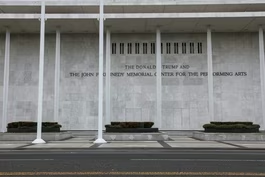
GEOFF BENNETT: Unless the courts intervene, the Kennedy Center for the performing arts will shut down this July for two years as part of a roughly $250 million renovation.
In the lead-up, there's been a wave of layoffs and a controversial rebranding under President Trump's allies.
But the questions are mounting.
Is a full shutdown really necessary?
Were artists critical of Trump pushed aside?
And did the center's finances deteriorate after new leadership took over?
Now Josef Palermo, an artist and arts organizer who served for the past 10 months as the center's first curator of visual arts, is speaking out.
He was among those laid off and has written a firsthand account in "The Atlantic" titled "What I Saw Inside the Kennedy Center."
And he joins us now.
Thank you for being here.
JOSEF PALERMO, Former Visual Arts Curator, Kennedy Center: Thank you for having me.
GEOFF BENNETT: So, in your piece, you noted that President Donald Trump promised the best is yet to come for the Kennedy Center.
But you write that instead you saw cronyism, incompetence, and a series of bizarre moves that would lead to the Kennedy Center going dark.
What did that actually look like in practice?
JOSEF PALERMO: Yes, I mean, the bizarre moves that I was referring to are largely centered around fund-raising and the tactics that were used to fund-raise.
And a lot of that seemed to be positioning the proximity of the president and his chairmanship of the Kennedy Center and essentially selling access to that through things like the preview event of "Les Miserables."
There was an evening last summer where it was reported that tickets were going for $2 million to sit near the president in his presidential box and attend a VIP reception.
I was also made aware of six-figure tickets in the orchestra level just because it was in the same room as the president for that performance.
And I just recalled thinking that this was not how we do things in the nonprofit arts sector.
And it's true that -- and I cite this in my piece in "The Atlantic" -- a colleague of mine actually said, we are grafting political management strategies onto a nonpolitical organization.
There were also very questionable things happening with respect to the lounges, these lounges that were established as gifts by different countries.
And in terms of the incompetence, I really just mean that to speak to the leadership that came in with no arts management experience and didn't really seem to care about having any arts management experience or motivation to do anything with the Kennedy Center other than show up on a red carpet and take pictures.
GEOFF BENNETT: You oversaw the center's collection of art, and you say that priceless works were taken down during the renovation.
What exactly was removed and do you know where it ended up?
JOSEF PALERMO: Right.
So I had been tasked by Grenell himself... GEOFF BENNETT: Ric Grenell.
JOSEF PALERMO: Ric Grenell -- to oversee, in his words, getting rid of the artworks in the Kennedy Center ahead of the renovations.
This was a directive that he gave me in his office shortly after Donald Trump made his TRUTH Social post about the closure.
I was told that we, the Kennedy Center, wanted new art to replace the outgoing art for the reopening.
And so what I was tasked with was contacting donors, and, in some cases, that's foreign nations that made donations to the American people by way of the Kennedy Center, and asked them to remove their work or in some cases paid to remove it if it was a statue that was installed outside that had to be dug up.
Without my knowledge, the African Room, which is again one of these lounges, that was something like 30, 32 African nations came together at the time the Kennedy Center opened to gift this lounge.
And inside that room were beautiful handmade tapestries from different tribes throughout the continent of Africa.
There was a sculpture from Ghana that represented the collective Africans' grief at the assassination of President Kennedy.
And there were ornate hand-carved wooden doors carved from 700-year-old wood that contained scenes of Yoruban village life.
That room is now completely gutted and emptied.
I was not told where those items went.
GEOFF BENNETT: The Kennedy Center told us in a statement in response to our question about this, they said: "There are currently no planned changes to art.
Our archivist is working to properly catalog the art.
We are working with conservators to inventory the artwork as we prepare for the closure and construction period.
"To preserve art during construction, some items may be covered, stored, or temporarily moved to ensure safekeeping."
How does that strike you?
JOSEF PALERMO: That's correct.
The archivist started about a week or two before I was laid off on March 26.
And I just hope that the Kennedy Center - - saying that you're moving things for safekeeping is great, but I hope that it also means that those items will be returned.
GEOFF BENNETT: So the official reason for this two-year closure, starting in July, is renovation.
Based on what you saw, do you believe that explanation?
JOSEF PALERMO: I do not.
As far back as August, I had been made aware of rumors inside the Kennedy Center that the CFO had been proposing closing the center at the end of September.
GEOFF BENNETT: Because they were losing money?
JOSEF PALERMO: That was what I was told, and that they were planning to use the cover of the renovations as a way to basically cease operations to stop the bleed of finances.
And I do believe that's attributed to the fact that Ric Grenell did not raise the money that he claimed he did.
And many public statements he made, that figure of $130 million, I believe that that's also what he told the president.
And I believe that the president found out that we didn't have that money, and that's why Ric Grenell is no longer the head of the Kennedy Center and why we are now, in fact, closing.
GEOFF BENNETT: In the piece you wrote for "The Atlantic," much of your criticism focuses on Ric Grenell, the former leader of the center.
As an employee, though, as I understand it, you praised his leadership, but now you're giving a very different assessment.
JOSEF PALERMO: I mean, Ric was my boss.
And I wanted to maintain a professional working relationship and environment.
I was not the only one, even among his own hires, who expressed criticism behind closed doors of his leadership and lack thereof.
But, obviously, I'm not going to go up to him and tell him these things.
GEOFF BENNETT: The Kennedy Center has always had a political dimension.
It is a federal institution.
Some would argue that every administration leaves its imprint on the Kennedy Center and other similar institutions.
Why does this moment rise to the level of desecration, as you put it in the piece?
JOSEF PALERMO: I firmly believe that our public arts institutions should never be politicized.
I think that the Kennedy Center belongs to the American people.
It's how we express our national cultural identity.
It's how we share that with the world.
And I'm coming forward as a whistle-blower because I'm calling on Congress to enact some kind of a firewall to prevent this from ever happening again.
And I believe that that should be a bipartisan effort.
GEOFF BENNETT: The administration will say that you are a disgruntled former employee with a motive.
JOSEF PALERMO: Well, I think the motive is, yes, I'm trying to stop their desecration of the Kennedy Center by any means necessary.
And I find that to be bringing the truth forward.
GEOFF BENNETT: Josef Palermo, thank you for sharing your insights and for joining us today.
JOSEF PALERMO: Thank you.
AMNA NAWAZ: President Trump claims that Iran has agreed to everything in talks with the U.S., including suspending its nuclear program.
That comes at the end of a week in which he feuded with the pope and two lawmakers suddenly resigned from Congress.
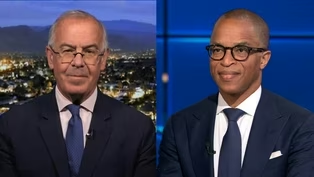
For all of that and more, we turn now to the analysis of Brooks and Capehart.
That is "The Atlantic"'s David Brooks and Jonathan Capehart of MS NOW.
It's great to see you both.
Let's start overseas, because there are a couple big headlines with the wars there, Jonathan, as you saw, a cease-fire earlier in the week with Lebanon to stop the fighting between Israel and Hezbollah, and then the U.S.
and Iran announcing the Strait of Hormuz is open, though evidence is suggesting otherwise.
There's also this, that the president says Iran says it's going to suspend its nuclear program, it's going to stop backing Hezbollah and Hamas, continuing to say the war is nearly over.
Do you believe that's happening?
JONATHAN CAPEHART: No.
I mean, this has been my issue with this war from the very beginning.
I have a hard time trusting what the administration says and certainly what the president says, just given how he brought the country into this war to begin with.
And we have seen him make very definitive statements, only to see action on the ground say otherwise.
And, also, I can't get over the fact that all of these things that we're talking about, the Strait of Hormuz has been reopened.
Well, it was open before the war even started.
Or things being talked about, about the plutonium.
Well, there was an agreement.
It's called the JCPOA, the Iran nuclear deal, that he ripped up when he came into office the first go-round.
So, sure, great.
I hope the president is right that the war is nearing an end, but until it actually ends, I will believe it when I see it.
AMNA NAWAZ: David, what about you?
Trump's saying that Iran has agreed to everything in the talks.
Do you buy that?
DAVID BROOKS: No, that's not credible.
I mean, the Iranians are more likely to convert to Christianity.
I do think that the entire world, except for maybe Bibi Netanyahu, wants this war to be over.
The American people clearly want it to be over, looking at the polls.
The Europeans do.
The Chinese do.
The Gulf states do.
I think the Iranians do.
I think they have taken some brutal assault, and the blockade of Iranian trade seems to be working.
And so I do think people want to be over.
But I don't think the Iranians are in any position where they think they have to give up everything, because they feel they sort of won this war.
And so the question will be over the next week, who can exert leverage to get at least as much as they can?
And, to me, I'd shrink the war aims.
Can we get the Iranian uranium, that's hard to say, in exchange for maybe releasing some of their funds?
And that would be fine.
At this stage, to do that would be something of an achievement to salvage from this war.
AMNA NAWAZ: I want to ask you also about something we reported on earlier, which is the president somehow feuding with Pope Leo.
Jonathan, we heard Liz reporting on it earlier as well.
In the way of background, Pope Leo issued a pretty strong statement rebuking the war in Iran.
Trump then unloaded on him online.
Vice President Vance jumped in to criticize him as well, telling him to be careful on matters of theology.
Is it smart for the president to be getting into it with the pope?
What does he stand to gain from that?
JONATHAN CAPEHART: No, it's not smart at all to be getting into it with the pope, to be fighting with the pope, even though the president says, I'm not fighting with the pope.
Yes, you are, and over something where it's like the president is taking the words from the pope very, very seriously, when any pope, Pope Leo, Pope Francis, Pope John Paul, would have been saying the same thing, because this is about life and death.
This is about right and wrong.
And it's something big that's happening in the world that has commanded the pope's attention.
The thing that I have that -- and so I'm not Catholic.
I went to Catholic school.
But I can understand Catholics in America, but around the world, being very offended by how the president has talked about the pope, talked to the pope, put images of himself as a pope.
And then just one other thing.
The vice president of the United States converted to Catholicism nine years ago.
For him to tell the vicar of Christ, who's been a priest for 34 years, that he needs to -- quote -- "be careful" about how he talks about theology is one of the most insulting things I think I could possibly ever hear being said, one, to the pontiff, but, two, from the vice president of the United States.
All of this is maddening and surreal.
AMNA NAWAZ: David, what do you think of this?
I mean, the way the president criticized the pope and then for Vice President Vance to speak of him the way that he did, what are you taking away from this?
DAVID BROOKS: Well, the president was sacrilegious.
The Easter texts were vulgar and crude on Easter, and then the Jesus image was legitimately sacrilegious.
And so I think one of the great cons that Donald Trump has pulled off is the idea that he's a man of faith.
And I think, after the last few days, even a lot of Trump supporters are acknowledging, well, he's not a person of faith, he's not a man of God, because nobody acts that way.
I agree with Jonathan that you shouldn't -- J.D.
Vance shouldn't be questioning the pope after being Catholic for 9.5 minutes.
But I do think what you see here is the contrast between the way Trump has gone into this war, which is cavalier in the extreme, and Catholic just war theory, which traced back to Augustine and Aquinas, which is intellectually rigorous.
And you have -- to be a just war, you have to clear a series of hurdles that make sure you're doing the thing right and you have thought about this carefully.
And in some ways, I do think they have cleared some of the hurdles.
There has to be just cause, it has to be morally righteous.
I think that's arguable.
But some of the other hurdles, it is clearly not a cause.
Is there right intention?
Donald Trump has not explained what our goals and intentions are.
So there's no right intention.
Is it last resort?
Have we given diplomacy every rule?
Well, obviously not.
Is there a probability of success?
Well, there was no clear probability of success, because it wasn't carefully calculated.
So one of the things you see with what the pope is doing, he's trying to put an intellectual, rigorous process on how you evaluate a very deadly policy.
And the Trump administration is completely incapable of thinking in these terms.
AMNA NAWAZ: Can I ask you both to weigh in quickly?
Because you both mentioned the images.
I want to remind people what those images were.
These were posted by President Trump, an A.I.
image of himself being held by Jesus, another one of him as Jesus, which he says he thought showed him as a doctor and he later deleted.
And then there's the one at the end there, which is him as the pope, which is from back in 2025.
Just very quickly, Jonathan, for people who previously said this is the president just posting jokes, do you think this is different?
JONATHAN CAPEHART: Which part of it?
I mean, the president -- they can say the president was just making a joke.
This is the excuse they use every time the president does something and then gets criticized for it.
But these images that he's been showing, to use the word that David used before, sacrilegious, blasphemous -- the idea that evangelicals, leaders of faith, Catholic leaders have not come out en masse and forcefully denounced the president for doing this is a bit mystifying to me.
I hope that that changes.
But he shouldn't be doing it.
And there should be other leaders, political leaders in his party who would have should have the guts to go to him and say, Mr.
President, perhaps you should be focused on lowering gas prices, figuring out affordability and health care than staying up in the middle of the night and generating means.
AMNA NAWAZ: David, briefly on the images, do people in his base, in particular, do you think that hurts him?
DAVID BROOKS: The Catholics who support Trump that I know were more offended, frankly, by the Easter texts or the TRUTH Social posts than by the images, because here was the day commemorating the risen Christ, and he was doing vulgar, profane, bloodthirsty texts on a day that shows he had no reflection of what this day was all about.
And I think that was shocking to some of his supporters, even more than the images, which could have been a joke, but tasteless.
AMNA NAWAZ: I do want to ask you about events on Capitol Hill, because we saw two resignations amid sexual misconduct allegations, one a Republican congressman, Tony Gonzales, and the other a Democrat, Eric Swalwell, who also, we should note, faces rape accusations, which he denies, and whose fall from grace, Jonathan, it's fair to say, was very, very swift.
Why do you think it was so fast and there was a bipartisan push in this moment?
JONATHAN CAPEHART: Well, I think when it comes to Congressman Swalwell, the accusations were very serious.
A big signal to me about the seriousness of the allegations against him was when Speaker Emerita Nancy Pelosi went on the record saying: As I have discussed with the congressman, perhaps he should deal with this outside of a run for office.
And so his gubernatorial campaign, to me, was on borrowed time.
And I also wondered if he would be forced to resign from Congress.
But then women started coming forward.
And we talk about the meteoric rise of people.
I don't think we have a corresponding word for the precipitous decline.
He was out within 48 hours or so of the original -- the original accusation.
That's been surprising.
But when it comes to Congressman Gonzales, we have been talking about that.
That's been a story in Washington for a long time now.
The fact that the two of them resigned and left Congress at the same time, I'm sure there's some politics involved.
I'm sure there's some House math involved because of the slim majority of Republicans.
But, either way, the focus should be on the accusers and their stories when it comes to Congressman Swalwell and the young woman who took her life who was involved with Congressman Gonzales.
AMNA NAWAZ: David, the final word here to you in the last 30 seconds or so.
DAVID BROOKS: Yes, I think this was so swift because of shifts in the culture over the last 10 or 15 years.
You start with the MeToo movement.
You go on to the Epstein case and the number of people who are willing to pal around with him.
And then you have these cases.
And I think it's become clear that the tolerance, the public tolerance, for monstrous behavior is low and that women know that there will be a support network for them.
And so this is a sign of moral progress that we're able to dismiss these cases with the speed which we just saw.
AMNA NAWAZ: We will take a sign of moral progress wherever we can get it.
David Brooks, Jonathan Capehart, thank you so much to you both.
JONATHAN CAPEHART: Thanks, Amna.
GEOFF BENNETT: Tune in tonight to watch "Washington Week With The Atlantic."
Jeffrey Goldberg and his panel look at the political impact of President Trump and Pope Leo's dispute over the war with Iran.
AMNA NAWAZ: This weekend on "Horizons," William Brangham and his guests discuss what it means to be a super ager.
And, on "Compass Points," guest host Lisa Desjardins and her panel reconcile Vice President Vance's isolationist views with his high-risk, high-reward assignment ending the war in Iran.
That's right here on PBS.
Check your local listings.
And that is the "News Hour" for tonight.
I'm Amna Nawaz.
GEOFF BENNETT: I'm Geoff Bennett.
Have a good evening and a great weekend.
Brooks and Capehart on Trump, Vance clashing with Pope Leo
Video has Closed Captions
Brooks and Capehart on Trump and Vance clashing with Pope Leo (11m 28s)
Ceasefire sparks cautious celebration in Lebanon
Video has Closed Captions
After weeks of fighting, ceasefire sparks cautious celebration in Lebanon (7m 22s)
Ex-Kennedy Center staffer alleges cronyism under Trump
Video has Closed Captions
Ex-Kennedy Center staffer alleges chaos and cronyism under Trump leadership (8m 17s)
How Trump's actions are affecting support among young voters
Video has Closed Captions
How Trump's recent actions are affecting his support among young voters (4m 30s)

Many Americans making tradeoffs to afford health care
Video has Closed Captions
One in three Americans forced to make financial sacrifices for health coverage (9m 57s)
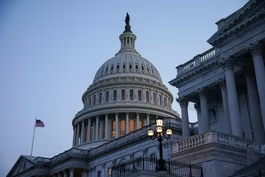
News Wrap: Senate approves short-term renewal of FISA
Video has Closed Captions
News Wrap: Senate approves short-term renewal of FISA surveillance program (5m 26s)

Timeline for Strait of Hormuz shipping recovery uncertain
Video has Closed Captions
Timeline for Strait of Hormuz shipping recovery remains uncertain (5m 26s)
Providing Support for PBS.org
Learn Moreabout PBS online sponsorship
- News and Public Affairs

Today's top journalists discuss Washington's current political events and public affairs.

- News and Public Affairs

FRONTLINE is investigative journalism that questions, explains and changes our world.












Support for PBS provided by:
Major corporate funding for the PBS News Hour is provided by BDO, BNSF, Consumer Cellular, American Cruise Lines, and Raymond James. Funding for the PBS NewsHour Weekend is provided by...