Arkansas Week
Arkansas Week: Opioid Crisis in Arkansas - October 23, 2020
Season 38 Episode 39 | 28m 23sVideo has Closed Captions
Special edition of “Arkansas Week” covering the Opioid Crisis in Arkansas during Covid-19.
Special edition of “Arkansas Week” with Arkansas Drug Director Kirk Lane, UAMS Director of Interventional Pain Management Services Dr. Johnathan Goree, FBI Little Rock Assistant Special Agent in Charge Scott Reinhardt and DEA Little Rock Assistant Special Agent in Charge Justin King.
Problems playing video? | Closed Captioning Feedback
Problems playing video? | Closed Captioning Feedback
Arkansas Week is a local public television program presented by Arkansas PBS
Arkansas Week
Arkansas Week: Opioid Crisis in Arkansas - October 23, 2020
Season 38 Episode 39 | 28m 23sVideo has Closed Captions
Special edition of “Arkansas Week” with Arkansas Drug Director Kirk Lane, UAMS Director of Interventional Pain Management Services Dr. Johnathan Goree, FBI Little Rock Assistant Special Agent in Charge Scott Reinhardt and DEA Little Rock Assistant Special Agent in Charge Justin King.
Problems playing video? | Closed Captioning Feedback
Where to Watch Arkansas Week
Arkansas Week is available to stream on pbs.org and the PBS app.
Providing Support for PBS.org
Learn Moreabout PBS online sponsorshipMore from This Collection
Dig into policy and the economy in these "Arkansas Week" episodes.
Video has Closed Captions
Common Ground Arkansas and Roundtable Commentary. (26m 59s)

Video has Closed Captions
I-40 Bridge Fracture and its Impact on Transportation and Commerce. (26m 20s)
Arkansas Week - April 30, 2021
Video has Closed Captions
Legislative Review, Redistricting, and Taxes (26m 58s)
Arkansas Week - April 23, 2021
Video has Closed Captions
Legislative Review, COVID Immunization Rate, and Governor Asa Hutchinson. (27m 16s)

Arkansas Week - April 09, 2021
Video has Closed Captions
Legislation on Social Issues and COVID-19 Vaccine and Communities of Color. (27m 8s)
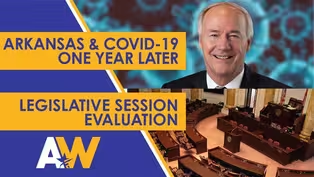
Arkansas Week - March 12, 2021
Video has Closed Captions
A Year in Review with COVID-19 and evaluation of the Legislative Session. (26m 36s)

Arkansas Week - March 05, 2021
Video has Closed Captions
Renter-rights Bill and Legislative update (27m 7s)

Arkansas Week - February 26, 2021
Video has Closed Captions
"School Voucher" Bill & "Abortion Ban" Bill (25m 54s)
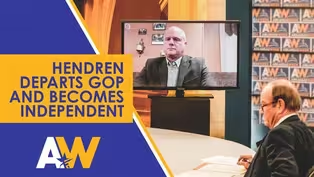
Arkansas Week - February 19, 2021
Video has Closed Captions
State Senator Jim Hendren announced that he is leaving the Republican Party. (26m 1s)
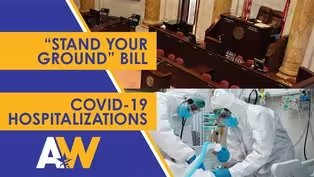
Arkansas Week - February 05, 2021
Video has Closed Captions
"Stand Your Ground" bill and Covid-19 Hospitalizations in Arkansas (26m 1s)
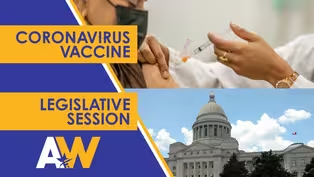
Arkansas Week - January 22, 2021
Video has Closed Captions
Coronavirus Vaccine and Legislative Session (27m 1s)
Providing Support for PBS.org
Learn Moreabout PBS online sponsorshipSupport for Arkansas week provided by the Arkansas Democrat Gazette.
The Arkansas times and Kuer FM 89.
And welcome again everyone to a special edition of Arkansas week.
Our focus in this broadcast involves health.
Not the coronavirus pandemic, but a different American epidemic.
An enormous problem that COVID-19 just may have made worse.
It could be accurately described as a pre existing condition.
It's opioid abuse.
In recent years, hundreds of arkansans and hundreds of thousands of Americans have died of it, countless others are enslaved by it and experts believe the emotional impact of the current virus that threatens us all threatens to drive a death toll from opioids and other drugs even higher.
So Red Ribbon Week.
The final days of October will see a campaign involving the State Department of Health and education, law enforcement and Arkansas PBS public service announcements, a statewide screening effort, and the presentation of a pretty sobering production.
That takes its title from a phrase straight from the addicts world.
Chasing the dragon.
And now our panel Kirk Lane is the Arkansas State Drug Director.
Doctor Jonathan Gorey is a pain specialist at the University of Arkansas for Medical Sciences.
From the Drug Administration, enforcement administrations, Arkansas Office.
Justin King is assistant special agent in charge, and Scott Reinhardt is assistant special agent in charge of the FBI's Little Rock Office.
Gentlemen, all of you thank you for being part of this.
Director Lane will start with you.
From a statistical standpoint, how bad are we right now compared to where we have been?
Well, one thing that is in our favor, we are trending downward and I think in the last year compared to 2019, nineteen was an actual pretty good year for Arkansas.
Based on the direction that we were going in the years prior to that, we actually drop down and overdosed this 18.1% compared to 2018.
I think this is probably attributed to all the educational programs that we have in place, and I say educational programs across the board from the drug take back to prescriber education to a medical assisted treatment.
Everything we do or everything the state has done to build collaboration, has an educational component in it and because of that giving good people good information has helped our program and develop what I call.
And infrastructure, not a strong infrastructure but add infrastructure, especially as we're dealing with Covid.
Well, a lot of social scientists, including psychiatrists, are medical professionals, psychiatrists, psychologists are concerned that the social isolation that's been brought about by COVID-19 the pandemic the shut down.
Could intensify feelings of depression, isolation, and the fact could in fact drive abuse up.
Or you share that concern.
It absolutely does.
We studied the last five months March through July of 2020, the beginning of covid months against the same months in 2019 we saw a spike in the lockson administrations not only in EMS, but in our own law enforcement program.
Significant spike.
We saw a drop in the treatment.
Admissions because.
Of the treatment centers protecting and CDC regulations about how many patients they could have in the home, and we feared that are overdose deaths were going up because of that.
But that's not what we found.
We found that we were trending in those months.
About 29 overdose deaths per month in 2019 were trending right now at about 26.8 overdose deaths per month in 2020.
In my opinion, based on the great efforts in the collaboration that we've been doing as a state.
To keep this program down or keep these numbers down, well, let's go to law enforcement for second 2 agents, King and Reinhardt.
I can't whine if it is these numbers being reflected in terms of the on the enforcement plateau, the enforcement plan, the availability of opioids.
Have you seen it?
A difference in recent years?
Either on the street or.
I'm sorry, I think that the computer froze up for a moment.
We didn't hear you.
We had a kind of computer I want to go to agents King and Reinhardt an ask.
How does from a law enforcement standpoint the availability of opioids and their use either through lawful means or through St dealings?
Your assessment in the in the past say half year.
Well, what we've seen is consistently over the last few years a rise in opioid availability that could be diverted Pharmaceuticals.
Or it could be heroin, fentanyl, heroin laced with fentanyl coming in from Mexican sources of supply, and we know that as people the availability is coming in and the demand has risen.
We've continued continuously seen over the last few months.
More and more of that brought into the United States.
And we see more availability that's making it more of a challenge for people, and we are number are seizures are up even during the pandemic.
We've seen a definite at least a steady supply of Pharmaceuticals fentanyl things of that nature.
We focused turn our attention towards overprescribing ready steady on that as well.
That's kind of where this starts a lot of times and so at least for the FBI's part.
We have the ability to go after that side of it worthy overprescribing is happening.
We work with DAD8 aversion to address that but we definitely have seen a steady supply on our end as well.
Well let me go to Doctor Gorrie.
Let's go to doctor or if we can right now, the diversion from providers.
Or we have to say some providers have simply been a huge part of the problem from a criminal standpoint is that are we making progress on that front in terms of educating providers?
And I think we're we're definitely making progress.
You know, one of the challenges that we had is we really understood that we were fighting an opioid epidemic.
But I think we also needed to focus on the underlying causes of that epidemic.
And that's really.
Chronic pain and the underdiagnosis and undertreatment of mental health conditions and through a number of partnerships with Kurt lanes.
Office with you.
AMS, the governors office and other funding agencies.
We've begun to really work to educate our physicians are physicians of today and our physicians of tomorrow to help recognize and remove the stigma of mental health conditions, but also to offer.
Opioid sparing effective treatments for chronic pain in acute pain and so as of right now, I'm really hopeful, and so it's a good enough time to introduce a segment from that stunning documentary.
By the way, produced with the assistance of the FBI, here's a scene from chasing the dragon.
Every generation seems to have their drug of choice.
Unfortunately, this generation seems to have found prescription opiates.
Is that drug of choice?
And even more unfortunately, the consequences of those drugs are far more devastating than anything else we've seen in the past, chemically and physiologically speaking, there's very little difference between oxycodone, morphine, and heroin.
It's just that one comes in a prescription bottle and another one comes in.
In a plastic bag.
Coming from a great family, you know always had what I wanted.
Never had a curfew.
I could sleep over at my friends house whenever I could have done anything they would have paid for me to go to any kind of school.
Stuff like that.
Any kind of they paid for guitar lessons?
I grew up with my dad.
My mom wasn't in my life, though he pretty much was mom and dad throughout the whole life.
He would tutor me for at least an hour.
On the weekends we go out would go camping.
We go out on the boats.
We always had something planned.
She started in gymnastics when she was like a toddler and she was a cheerleader through middle schools, high schools and she was also a competitive cheerleader.
She started competing probably in 7th grade.
Worked myself up through the years.
With minimal college.
To position, I worked as a corporate account executive was making about an average of 122 thousand a year.
Things were pretty pretty good financially.
River secure kids were happy we were.
We had no real issues.
I had a great childhood, great family.
We did a lot of camping, alot of fun stuff going to the beach, camping at the beach.
Very active in Scouting, Boy Scouts and something my father, me and him did together.
You know, a couple days before my 18th birthday actually got my Eagle Scout, which was a big accomplishment for me.
I met my first husband when I was very young.
I was 13 and then we got married at 17 so I got to grow up pretty quick.
I was 22 years old and that's when everything started.
I got pregnant with my youngest daughter.
Once I had her, they gave me oxy cottons.
That was the pain medicine.
From them, knowing that's where my addiction started.
Introduce a sort of a breaking news element of this broadcast, and by the way, we're taping it on about Thursday, October 21st.
Earlier today, a major American pharmaceutical company agreed in its latest litigation to pay almost 8 billion 300 million dollars in both civil and criminal fonts.
Of four in effect.
Prosecutors allege pushing opioids and being less than forthcoming about the addictive potential of those, so I'd like to open it up in.
Kirkland will go back to you first.
The treatment community, the providers, and other statistical Washington Post reported last year, and I was staggered by this to a gentleman over a six year period ending in 2012.
Arkansas providor pharmacies received 9.
100 million opiates.
Adult individual doses?
That's that's 300 per person.
Over that entire for each year of that six year period, you know the numbers are staggering.
We're still the second highest opioid prescribing state in the nation.
We've come down significantly.
I guess a win win is right now we're at 93.2 opioid prescriptions for every 100 people in Arkansas were at the lowest level we've been since 2006, and we've been as high as 121.
We still have some counties that in that level.
So we have a lot of work to do in our state of bringing this.
Step into substance use disorder that we're seeing and prescriptions.
Play a factor in that.
Yeah, let me go to agents King and Ron Artest again.
If I may, gentlemen, what in terms of the volume of abuse in opioids, how much of it is diversion?
Miss prescribing, so to speak, and how much from?
I. Foreign sources, let's put it that way.
Well it the over prescribing is a lot of times where this begins.
Most of the opioid drug addictions in particular start at home with friends or families and most of the time it's somebody either sharing medication or somebody using a medication.
And what happens as the disease progresses.
And you can no longer get a prescription or you can't afford it anymore.
You go to the street to try to find pills or whatever it is you had in the medicine cabinet at home, and then when you can't afford that anymore.
That's when you start seeing users go to heroin and much more dangerous substances.
And lot of times those and other drugs that you buy the street level over laced with fentanyl, which is a very deadly hoping wait in so.
We we see the issue starting at home so.
And that is coming over the border in large quantities.
But both are problems, but it really starts a lot of times at home and chasing the dragon as you just saw.
Most of the folks there had a great life.
Lot of times it just starts there and.
Progress is, yeah agent King.
Please go ahead.
Yeah, and another thing that we found with all types of drugs is that there's more availability on the street.
There's more opportunity for people to be offered something that maybe weren't necessarily starting with a doctor.
For example, at a college or at a high school where somebody may have become addicted and they are offering it up at a party or something like that.
And the other thing we're seeing is there's a large large volume of counterfeit.
Pharmaceuticals that are brought in from Mexico and they look the same, but they may be all fentanyl and so the drug trafficking cartels are taking advantage of the weakness of the people, and they're they're flooding the market with these things to try and get more people addicted 'cause they want to sell more of their product.
And I think perhaps fentanyl deserves special mention.
Gentlemen, simply becausw of its incredible lethality.
Yes, yes the the fentanyl is is the potency of it is so much that it doesn't take much fentanyl and plus the price of it.
It's so it takes a lot to produce heroin.
It's a. It's a very lengthy process.
You have to grow the Poppy and it takes a long time, whereas fentanyl can be made in a lab an when you're talking about something that is so extremely potent, a small amount of it that can be sold for sometimes you know $5000 of kilo of fentanyl as opposed to.
$45,000 for a kilogram of heroin on the street.
You can see how the profit margin really goes up for that drug trafficking organization.
Let's go back to our physicians.
Are these amounts that are being shipped to Arkansas from the pharmaceutical companies too?
An are prescribed legitimately.
Or at least by legitimate providers.
Anyway, the license providers.
Let's put it that way, are absolutely staggering.
Your thoughts on that?
I agree 100% and I think that we have taken on a new concept that we call opioid stewardship in the medical community and it started with antibiotics about 20 years ago where when I was a child.
If I had the sniffles, I normally got an antibiotic and we learned that we were doing more harm than good by overprescribing antibiotics, even though they are effective in certain circumstances.
We take in that kind of similar thought process to opioids now.
We now know that about 50% of opioids that are prescribed after a acute pain event like a surgery often go unused.
Those opioids can sit in the medical and medicine cabinet and easily be diverted so we are having conversations as a medical community.
But even internally in our hospital system about what is the correct amount of opioids to prescribe and when should they be prescribed and when are they most effective?
And I think we know through research that's been done here.
And at other institutions that the longer a patient takes opioids, the more they are at risk for developing opioid use disorder or chronic use.
And so we have to be better stewards and make sure that we prescribe them for specific indications and make sure that we are prescribing the correct quantities and not just prescribing a large amount that patients can use for other for other reasons or directly.
I would agree.
I think he's hit it straight on, you know we have a fabulous prescription drug monitoring program that we put in place in 2016 that really helps us with understanding that prescribing helps us track trends.
Help us reduce doctor shopping.
It needs to be a little more effective.
It had a slow buy in from the prescribing community, but now it's starting to take root understanding of such a valuable tool to help us get ahead, allow the numbers that you see that you're quoting come from the prescription drug monitoring program and in before 2016 we weren't able to get those numbers.
So now that we can see it and use those statistics to guide efforts of trying to correct problems and trying to make a resolve.
The prescription drug monitoring program really helps us let's pause for a second and go back for another excerpt from our documentary chasing the dragon.
First time somebody uses.
An opiate drug.
That the euphoria that they get is is something that they continue to search for and seek for.
So while you could do that in the beginning by just chewing on the drug overtime, you can't get that high anymore.
So now you have to take it up to the next level.
An nobody sets out thinking that they're going to end up being a needle user.
You still chasing that first high.
So.
So you know, in order to be high, you got at least be.
Normal and to get there you got at least do enough to where you're not sick anymore.
So if I had stuff a day before, I always save it back for the morning time so I won't wake up.
I could get well and I call it that because in the end.
I wasn't using to get high anymore.
I was using to stay well so I wasn't sick.
You know, I'm not even getting high.
I'm just trying to, you know, be able to get up out of bed.
I feel like I've missed a couple years in my life because there's a lot that it's just a fog.
Black fog, 'cause you know?
Really wasn't there?
I can tell myself no, no no but my body as soon as you think about it, you get anxiety.
Your palm started to sweat.
You know your mental, your mental ignores your physical part of it.
I am very angry.
And one of the things I'm most angry about, Anne.
I tell her all the time.
Is that?
That drug.
Was so much more important to you than me.
An I'm the one that can help you.
I'm the one that helps you.
I'm the one that supports you.
I'm the one that will always be there for you.
You need something I'm going to be the one to take care of it for you.
But something.
That literally destroyed everything good within you.
With so much more appealing.
Wanted that so much more than anything I could offer her.
And I'm angry.
I am angry about that, so everything came to a head.
I was writing prescriptions and full on with my addiction.
And I ended up getting caught going to jail.
And while I was in jail, my daughter got involved with some friends from understand her friends were all doing prescription pills.
I had no idea I didn't even know his problem.
I just saw was my problem, it was.
Saturday morning, Saturday afternoon.
I was in the jail and they came down and told me they needed to see me and I went up and because her father not were both arrested for the same thing were both there.
So I saw him coming in.
Detectors came and told us that you know what happened.
Apparent overdose and that she was initially, they said she'd passed and then they said she was in ICU.
Struggling for life.
You want me to?
You talked to the doctor and doctor recommended I disconnect all life support and I refused.
And then it's seven resuscitation efforts I guess.
And eventually you know that morning she passed away.
This is real and I will say 'cause I remember being that teenager too so I know it's like their market but it's real and once I mean I think I'm still in shock like it is hard.
I don't even know how to put it into words.
Maybe that's why I'm able to deal with it 'cause so mind numbing.
Does someone you love that much?
She was my first love.
So when you love that much, you can lose like that and you can't go back and say I'm sorry or set a better example or talk him out of it.
Sarah died February 18th.
Get out still calling her still calling her.
It's that powerful that you could spend seven months clean.
Clean and being educated on nothing but how to beat it, how bad it is for you.
You know all this and you last six days.
Red ribbon week.
Let's go to agent Reinhardt.
Because the FBI is is a key part of this, Sir, what?
What makes this different?
Some of us are old enough to remember.
In a previous presidential administration in an earlier century, just say no became the phrase.
But, but too many people kept saying.
Guess what makes Red Ribbon week and this new thrust effective?
Or do you hope will make it work?
Well, this is an effort with the FBI, the DSO for our partners to get the message out to school age kids.
And I mean everybody in secondary schools, colleges, universities to educate them on the separate epidemic.
And you see how powerful this film is, they get the word out too.
You know, I speak a lot around the state about this epidemic, specially during Red Ribbon Week in my main message to everyone is a lot of the community looks to law enforcement to fix this problem, but we will never arrest our way out of this problem.
And so back in 2017 that got the DEA came together and put this film together to get a very powerful message out.
To everyone of how this epidemic begins, aggression and things that look for and so that we can have that very sobering discussion.
I'm heartened by what I've seen here in Arkansas about 85% of the schools here in Arkansas and viewed the film by 33,000 students so far, so we're very pleased with that.
Under normal conditions were in the schools with them to answer questions, and we get some really tough questions we.
Thought the kids I will set the first viewing of this film an we actually had a student stand up and talk about student who was * **** and it was actually him and you could have heard a pin drop in the in the room.
He actually shared it with the entire class that was there.
There was actually a doctor as well and I've seen some of the medical community start to come out for these viewings as well and I'm very encouraged by that.
So it's an effort to bolster our law enforcement efforts not by just going out.
And in doing this from a lot of enforcement standpoint but also an educational standpoint, yeah and doctor do you see the paradigm shifting a little bit away?
Maybe not necessarily away from law enforcement, but to emphasize education and early treatment prevention.
I think so.
I think we all need to work together and I think we're doing a better job of doing that at the beginning of the epidemic.
I think we really did focus on prohibition or getting the drug out of people's hands.
The challenge with that is we kind of watched a prescription drug epidemic turned into a street drug epidemic of heroin and fentanyl, and so prohibition can't work alone.
And we need education.
We need proper treatment of mental health disorders.
And we also need good quality medical care and so all of us.
And that's why I think this is such a great panel.
All of us come at this problem from different from different viewpoints, but I think all of our viewpoints are important and all are needed to really bring about an effective solution.
Director Lane in the interim anyway.
In emergency situations there is a new tool, sure on the lock.
So Narcan is an opioid antagonist that allows somebody to breathe, or not yet.
Opioid overdose is has resulted in countless saves in our state, about 270 a month on EMS, 668 on our law enforcement side, people have been saved.
It gives the ability to somebody to get a second chance or third chance to seek treatment and recovery.
It makes the difference alright to all four of our guests.
Thank you gentlemen very much for being part of the broadcast, and one more reminder, red Ribbon Week Arkansas PBS.
Sign on please.
Thank you for joining us.
See you next time.
Support for Arkansas week provided by the Arkansas Democrat Gazette.
The Arkansas times and Kuer FM 89.
 New Episode
- News and Public Affairs

Top journalists deliver compelling original analysis of the hour's headlines.
 New Episode
- News and Public Affairs

Today's top journalists discuss Washington's current political events and public affairs.


 New Episode
 New Episode
 New Episode
 New Episode
 New Episode
 New Episode
 New Episode
 New Episode
Support for PBS provided by:
Arkansas Week is a local public television program presented by Arkansas PBS