
What the Iran war’s economic fallout means for the midterms
Clip: 5/1/2026 | 13m 1sVideo has Closed Captions
What the Iran war’s economic fallout means for the midterms
Fallout from the Iran war has created economic woes ahead of the midterms. The panel discusses Trump’s goals in the Middle East and the effects they may have on control of Congress.
Problems playing video? | Closed Captioning Feedback
Problems playing video? | Closed Captioning Feedback
Major funding for “Washington Week with The Atlantic” is provided by Consumer Cellular, Otsuka, Kaiser Permanente, the Yuen Foundation, and the Corporation for Public Broadcasting.
What the Iran war’s economic fallout means for the midterms
Clip: 5/1/2026 | 13m 1sVideo has Closed Captions
Fallout from the Iran war has created economic woes ahead of the midterms. The panel discusses Trump’s goals in the Middle East and the effects they may have on control of Congress.
Problems playing video? | Closed Captioning Feedback
Where to Watch Washington Week with The Atlantic
Washington Week with The Atlantic is available to stream on pbs.org and the PBS app.
Buy Now

10 big stories Washington Week covered
Washington Week came on the air February 23, 1967. In the 50 years that followed, we covered a lot of history-making events. Read up on 10 of the biggest stories Washington Week covered in its first 50 years.Providing Support for PBS.org
Learn Moreabout PBS online sponsorshipJeffrey Goldberg: Ashley, the -- I mean, as I noted before, the president is still the president.
You and Michael Scherer this week wrote a piece.
I want to read something.
I mean, you talked about the president's grand vision of himself.
You wrote, Trump's heightened tendency to view himself as a world historical figure, capable of brash, misunderstood greatness, has transformed his second term not necessarily in a good way.
Republicans are in a panic about the political costs of the attack in Iran, which has increased prices and interest rates ahead of an election that will hinge on affordability.
I want to go to Idrees in a second to talk about the actual core issue here, but give us a little sense of the argument of the piece and what you have seen in Trump that's changed, that caused you to want to write this.
Ashley Parker: Yes.
So, Trump's second term feels so demonstrably different than his first term.
And we were sort of reporting and thinking about questions of legacy.
He's not behaving the way you rationally would as a second term president who has a party that is facing what's looking to be an increasingly close midterm election.
And he's also doing another thing that most presidents do, which is remaking the city in his image and putting his physical image on just about anything he can in building arcs to himself.
And so we started to ask these questions, and one thing we heard was that Trump privately had begun comparing himself to Alexander the Great, Napoleon, and Julius Caesar.
And what we realized in talking to people around him, someone told us, look, he is talking about himself as potentially one of the most powerful men who has ever lived and will ever live.
And he has seen himself in these terms.
He has seen himself in the broader scope of history and there is a sort of freeing of his ambition and his whims.
The guardrails are gone and he doesn't particularly care if Republicans hold the House.
He cares a little more if they hold the Senate because that may make a difference in an impeachment trial and he sort of cares about a successor, but that too is complicated because he doesn't want anyone usurping him.
And that's sort of what our piece explores.
Jeffrey Goldberg: Right.
So, Idrees, before you can be Caesar or Napoleon, you've got to get gas prices down.
Idrees Kahloon: Yes.
Jeffrey Goldberg: I mean, they had that same problem.
Talk about the president's economic woes and how long lasting they might be meaning into the fall, into the election season.
Idrees Kahloon: Yes.
I mean, the fact that the oil is not flowing will be a problem.
You know, you can't just restart these refineries in the Gulf like that.
They take a while to come back online.
It's unclear even if they will.
America's exposed to international markets.
So, Asia is going to be affected a lot sooner than America because of their dependency on Gulf oil.
Europe will as well.
That will affect American markets.
But even here, you see gas prices are up 50 percent, consumer confidence from the University of Michigan's surveys at its lowest point ever, ever right now.
You know, the U.S.
economy is still, on the whole, doing a lot better than Europe, but people have been feeling glum about the economy for a really, really long time.
This is really not the set of economic priorities that you want to be sending before you go into the midterms.
Mortgage rates are going to go up.
Farmers, you know, the constituency that Trump really professes to care about have been affected not just by tariffs, but now added fertilizer prices because of the Gulf, increased diesel prices, you know, airlines are going to get more expensive.
It's just not the right condition for a president who wants to win the midterm elections.
And, really, it's also not the right condition if he wants to run for a third term, which it doesn't seem like he is at all, right?
Jeffrey Goldberg: Right.
What would it take and how long would it take to unwind these things in a way that, by September, give him a better shot, give the Republicans a better shot at holding Congress?
Idrees Kahloon: I don't think it goes back just like that.
I mean, there are, you know, these -- Jeffrey Goldberg: Not just on the flow of oil, but all these things?
Idrees Kahloon: Yes.
No, it takes a while.
You know, like business uncertainty, for example, has gone up a lot, right?
The Federal Reserve is not going to cut, as was expected.
So, people who were going to buy a house this summer just won't be able to.
And even if this stuff is resolved tomorrow, all of that does not change and all of those economic conditions are just going to persist for at least a while.
And that's to say nothing if this goes on for longer and countries like Japan are affected, Europe's affected, you know, that then it gets really bad.
Jeffrey Goldberg: Right.
Peter, there's been some compelling reporting that that says that the Iranian economy is on the brink of collapse because of the blockade.
So, does the president actually have a patient plan to bring about regime change that would really change the Middle East over time?
I'm not asking in relationship just to the midterms, but, more generally, is he on a pathway that is actually smarter than conventional wisdom would have it?
Peter Baker: Well, look, we'll see.
But I think that in Washington, we have traditionally, historically over overestimated our ability to affect other countries' governmental systems, right?
We have been squeezing Iran historically under presence of both parties now for decades with sanctions that are tougher than most countries have ever endured, and it made no difference whatsoever in terms of who was running Iran.
We've been -- we've had Cuba in a chokehold for 60, 70 years.
It did not change who runs Cuba.
We have not changed who runs North Korea by cutting off all the things we have cut off from them.
So, I think that, yes, maybe this could happen.
I don't want to rule anything out, but history suggests that we have limits to our ability to affect other countries' governments.
Jeffrey Goldberg: Right.
Susan, Pete Hegseth, the Secretary of Defense, went to war against Congress and the Democrats this week.
Let's watch this.
Pete Hegseth, Defense Secretary: The biggest adversary we face at this point are the reckless naysayers and defeatist words of Congressional Democrats and some Republicans.
Jeffrey Goldberg: I would argue that the biggest adversary we face is some combination of Shia and Sunni terrorist extremism, Russia, and, as a long-term threat, China.
But also, you know, Pete Hegseth is arguing that Congressional Democrats are the same.
He was incredibly pugnacious in these hearings.
And the administration, as we know, just announced in anger that it's going to withdraw 5,000 American troops from Germany as a way of punishing the German chancellor because -- who said that Iran is humiliating the United States.
Give us your sense of this brittleness and this anger coming out of the Pentagon.
How serious is it?
And what does it mean for that, for the war effort and for relations with Congress that has to fund this war, this war effort?
Susan Glasser: Yes.
I mean, Donald Trump and Pete Hegseth have thumped their nose at Congress since the very beginning of the administration.
And what's been notable is that while Republicans control both chambers, they've done almost nothing to it.
You know, in fact, it was remarkable to hear King Charles of Britain give a speech to Congress this week where he mentions the Magna Carta and says, you know, that this is a great progenitor of America's checks and balances and the great members of Congress who've done nothing to serve as a check on Donald Trump rose in a bipartisan standing ovation.
As far as Pete Hegseth goes, I'm really -- Jeffrey Goldberg: Do you think the king was smirking a little bit on the inside, like he got a funny joke over Congress?
Susan Glasser: You know, the British do dry wit better than the Americans do.
What's amazing is that Donald Trump didn't seem to get the joke and he later called it a fantastic speech.
But I want to answer about Pete Hegseth.
I'm really glad you played that clip.
Because, to me, that gets at the essence of what he and Trump have been doing that is so different.
They redefined national security from the very beginning of this administration as about the enemy within.
Donald Trump gave a famous interview in October of 2024 in which he was asked about who was America's greatest adversary.
And he said, you know, there's Russia, there's China, and then there's the enemy within.
And of those, the greatest threat is the enemy within, Hegseth now defining a new set of enemy within.
I think they've redefined how they see the role of the military.
And it's a vision, by the way, of unchecked executive power.
Because what it means is that if Donald Trump or Pete Hegseth identifies someone as an enemy, they could use this vast powers at their disposal without anyone in Congress or anywhere else doing anything about it.
Jeffrey Goldberg: Idrees, do you remember any period in American history in which a Secretary of Defense has argued that the greatest enemy facing the United States is -- are members of the opposing party?
Idrees Kahloon: I mean, I don't.
But, you know, there's traditionally a sense of gravitas, of purpose that the defense secretary has when they carry themselves, that the president has when they carry themselves, that obviously you don't see here.
And the fact that you have, you know, as you pointed out, the king talking about checks and balances, which we are very different from the English system, right?
He's sort of reminds, he's sort of giving constitutional lessons to the president.
I found that very odd.
And also the fact that he got tariffs removed on scotch whiskey was also a kind of inversion of, you know, 250 years ago, we're protesting tea tariffs imposed arbitrarily by the king of England.
Now, the king of England is sort of begging our leader to please remove these tariffs, so we'll see.
I mean, it's all very odd.
And this is obviously, of course, a power that is core to Congress, right?
Article 1, it's right there.
Jeffrey Goldberg: Right.
It is actually astonishing, if you think about it, that a descendant of King George III is lecturing appropriately, in many lights, the United States on democratic behavior, but here we are.
I want to ask about the Democrats.
They're very fired up right now, Peter, so fired up that the populous seemed to be on the march.
Graham Platner in Maine has a clear shot of the Democratic nomination for Senate.
And this just really struck me.
Democrats seem very inclined to forgive him for having a tattoo -- an SS tattoo, a Nazi tattoo.
I've been surprised at the double standard here, a Republican candidate for Senate had an SS death head tattoo.
I don't think the Democrats would be so forgiving.
What's going on?
Peter Baker: No.
Well, they want to win.
That's what's going on.
Look, when it's your side, you're always more forgiving than it's the other side.
Why are Republicans always forgiving of Donald Trump?
Because it's their side.
So, Democrats are being forgiving of Graham Platner because they want that Senate seat.
And that's one of the most vulnerable Republican-held Senate seats in the country.
Now, is he the guy to take it?
You know, he says, by the way, in fairness to him, that he didn't know it was an SS symbol, but he said plenty of other incendiaries and provocative things that he's had to take back and apologized for over the years.
And it gives a lot of people some, you know, a concern about whether he is up for that job.
But he is a champion right now of the progressive left.
He has now essentially defeated without even getting to the primary, the sitting Democratic governor who was the choice of Chuck Schumer and the establishment of the party, forcing her to drop out.
So, the progressives feel like they have a little bit of head of steam there.
Whether that works in the general election, I don't know.
It works in the Democratic primary maybe.
That's the question.
Jeffrey Goldberg: Well, that's the question, Susan, is the populist surge great for certain candidates in the primary season?
And then the reality is he has to run against Susan Collins as a Maine institution.
Susan Glasser: Well, that's right.
I mean, she's much more vulnerable, I would say, now than in her previous bids for reelection.
But, you know, look, it's always hard to generalize, right?
In Texas, you had a Democratic Senate primary in which it was James Talarico, who was, you know, really the more centrist candidate who won that contested primary.
And he's now giving Democrats a shot, a very unlikely shot, I'll believe it when I see it, but, you know, at least a shot in deep red Texas at a seat because, in fact, he didn't come from the far left of the party and he's preaching a very different kind of message.
So, I think it's hard to generalize, Jeff.
I do think Democrats are in verging on what might have been called a little bit of irrational or maybe rational exuberance headed into these midterm elections.
There's a lot, including redistricting, that could still go wrong for them.
Jeffrey Goldberg: Right.
Susan Glasser: But Donald Trump's numbers make them the favorites in many respects.
Jeffrey Goldberg: Idrees, quickly the decision by the Supreme Court overturned this gerrymandered district in Louisiana portends not such good things for the Democrats.
Idrees Kahloon: Yes, but it's close enough to the primary dates and not that many states are going to modify their lines.
Jeffrey Goldberg: It's too late to modify the line.
Idrees Kahloon: Louisiana will try to do that.
Florida will try.
But the real effect will be felt in 2028.
Jeffrey Goldberg: Right.
Ashley, last word to you on the Democrats and this rational or irrational exuberance on the left.
Ashley Parker: I mean, I think this is -- you're seeing it in different states, but this is going to be the key debate we see play out this divide in the party in the 2028 primaries.
Jeffrey Goldberg: Well, thank you very much.
We're going to have to leave it there.
There's so much to talk about, but I want to thank our guests for joining me
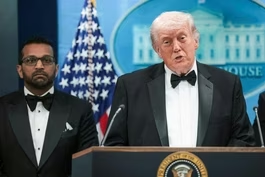
Two sides of Trump’s reaction to the WHCD shooting
Video has Closed Captions
Two sides of Trump’s reaction to the White House Correspondents’ Dinner shooting (9m 55s)
Providing Support for PBS.org
Learn Moreabout PBS online sponsorship New Episode
- News and Public Affairs

Top journalists deliver compelling original analysis of the hour's headlines.

- News and Public Affairs

FRONTLINE is investigative journalism that questions, explains and changes our world.
 New Episode
 New Episode
 New Episode
 New Episode
 New Episode
 New Episode
 New Episode
 New Episode
Support for PBS provided by:
Major funding for “Washington Week with The Atlantic” is provided by Consumer Cellular, Otsuka, Kaiser Permanente, the Yuen Foundation, and the Corporation for Public Broadcasting.