Here and Now
Here & Now for June 5, 2026
Season 2400 Episode 2447 | 26m 47sVideo has Closed Captions
Watch the entire episode of Here & Now for June 5..
Watch the entire episode of Here & Now for June 5..
Problems playing video? | Closed Captioning Feedback
Problems playing video? | Closed Captioning Feedback
Here and Now is a local public television program presented by PBS Wisconsin
Here and Now
Here & Now for June 5, 2026
Season 2400 Episode 2447 | 26m 47sVideo has Closed Captions
Watch the entire episode of Here & Now for June 5..
Problems playing video? | Closed Captioning Feedback
How to Watch Here and Now
Here and Now is available to stream on pbs.org and the free PBS App, available on iPhone, Apple TV, Android TV, Android smartphones, Amazon Fire TV, Amazon Fire Tablet, Roku, Samsung Smart TV, LG TV, and Vizio.
Providing Support for PBS.org
Learn Moreabout PBS online sponsorship>> The following program is a PBS Wisconsin Original production.
>> President Trump makes a visit to Wisconsin, and so does his health secretary, both here ahead of the midterms to stress the importance and survival of dairy farms.
[MUSIC] I'm Frederica Freyberg.
Tonight on "Here& Now" we talk with the incoming chairman of the Wisconsin Elections Commission about new federal rules on absentee ballots and the FBI probe in Milwaukee into the 2020 election.
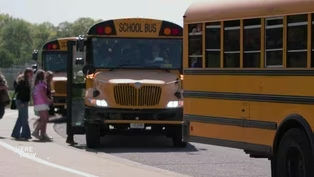
We have a report on the number and reasons why so many rural schools across the state are closing their doors permanently.
And we hear what the president had to say today during his visit to Wisconsin.
It's "Here& Now" for June 5th.
>> Funding for "Here& Now" is provided by the Focus Fund for Journalism and Friends of PBS Wisconsin.
>> A new national Marquette Law School poll has Donald Trump's overall approval rating continuing to decline, now down to 38%.
The survey shows approval of his handling of the economy at 30% and 19% for how Trump is handling the spike in gas prices set against this sentiment heading into the midterms.
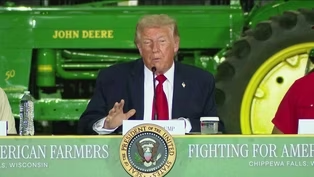
President Trump visited western Wisconsin today to rally support for his ag policies and to lend a campaign boost to state Republicans running in November.
>> We're at a point we're going to come out of Iran very quickly, and it's going to be very strong one way or the other, whether it's a piece of paper or the very tough way.
Okay.
The very tough way is maybe the easier way, but we're going to come out and your fertilizer prices are going to go way down, just like they were four months ago.
Your fertilizers down, your energy's down your oil.
Your gas is all coming way down.
And frankly, I thought it would go much higher than it did.
I thought, frankly, that gasoline would be much higher every day.
My administration is fighting to protect and defend the jobs and livelihood of our great farmers.
I love our farmers, our growers, agricultural producers, ranchers from coast to coast.
And I just see that dairy exports have surged nearly $1.2 billion under our leadership.
And just and this is with a conflict going on.
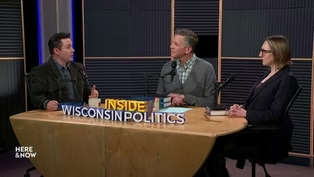
>> Although President Trump retained strong positive influence among Republican primary voters in light of his overall slipping poll numbers, this week's episode of Inside Wisconsin Politics considered the optics of Republicans running for Congress or governor campaigning alongside him.
Here's what they had to say about it.
>> If you look back in history more on the Democratic side, there is a history of some candidates not only not sure if they want to sit next to an unpopular president in a midterm election.
In 2010, President Obama came to Madison.
There was a big question of whether Russ Feingold was going to appear on the stage.
In the end, he did.
But all the weeks leading up to it, his campaign wasn't sure he might be in Africa.
He had some other things going on.
And that was really a political question of does he want to be seen with him?
And he ended up losing that race.
That was the Tea Party wave before it was just two years ago.
President Biden visited Madison off that disastrous debate performance.
Tammy Baldwin was elsewhere.
She didn't come to Madison to be with the president.
That's about campaign optics.
>> The president right now has some of his lowest approval ratings throughout his time in office.
But farmers in particular have really helped deliver him victories.
I believe in his last election, he won the vast, vast majority of farm dependent counties in the country.
And yet a lot of his policies, tariff policies in particular, have really been connected with some of the pain that farmers have been feeling.
So tariffs that have caused, you know, weakened overseas markets for for corn and soy, and then increased prices on steel and aluminum.
So we have seen changes in his policies in ways that are, I think, aimed really directly at trying to appeal to these farmers.
Earlier this week, he signed an executive order to lower some tariffs on agricultural equipment in particular.
And so now he's coming to Wisconsin to talk directly to farmers and kind of try to make sure that that part of his base is secure.
>> The Republicans need this area, and they need Trump's voters to come out when he is not on the ballot.
Republicans across the state struggle to get turnout, especially in western and northern Wisconsin.
That is the Maga base of this state in the seventh and the third.
And without those voters, they could really struggle in the fall.
So they actually need to attach themselves even closer to Donald Trump at this point, even if it looks like, politically speaking, it may not be the smartest move because of his terrible numbers on a lot of things.
>> For their part, upon Trump's visit, Wisconsin Democrats called the president's farm policy and the war in Iran a disastrous agenda for farmers across the state.
>> This president has launched us into an illegal, an entirely unnecessary war in Iran.
This war that no one wanted has tragically taken the lives of 13 service members.
It's taken the president's time and focus and has taken money out of the pockets of our farmers.
Because of this war, diesel prices hit record highs in Wisconsin last month, up 80% from the year before, and global fertilizer prices have jumped 50% in recent months.
Farmers are paying more for their inputs and getting less for their outputs.
Because President Trump and my Republican colleagues in the Congress and their policies.
For many farmers, this means an impossible choice sell at a loss or pay to store crops and hope that prices improve in the future.
>> Even as the president and members of his cabinet make campaign swings through Wisconsin this week, the Trump administration is working behind the scenes on the electoral process leading up to the November elections.
This week, the U.S.
Postal Service released its proposed rule attached to the president's March executive order, titled Ensuring Citizenship Verification and Integrity in Federal Elections.
That's an order.
Governor Tony Evers at the time called BS.
The order instructs the Departments of Homeland Security and Social Security to send state election officials lists of confirmed U.S.
citizens and prevents mail in ballots to anyone not on the list.
Add to that, the FBI has been in Milwaukee interviewing and seeking to talk with election officials who worked the 2020 election that Trump declares he actually won but didn't.
Trump maintains his loss was a result of widespread voter fraud, which never proved out.
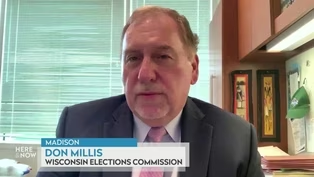
Set against all this, we turn to Wisconsin Elections Commission chair elect Republican member Don Millis.
And Mr.
Millis, thanks very much for being here.
>> Great to see you.
>> So is it another rough and tumble election cycle staring down the Wisconsin Elections Commission?
>> Well, more.
The rough and tumble certainly is going to be in the political ads that are run between the candidates.
You know, this has always been an issue for the elections Commission.
You know, counter lawsuits and proposed regulations.
You know, I'm not I'm not too worried about it.
I know that the things that really bother me the most are that concern me the most are making sure that absentee ballots, if they're mailed back a week or two before the election, they get there on Election Day.
Those are things that we're working to try to working with the post office to make sure that that happens.
Those are the things that concern me the most.
>> Because Hodek has called on the U.S.
Postal Service to speed up deliveries of absentee ballots.
After I read two thirds of of clerks reported mail delays during the April 7th election, how bad was it?
>> Well, it was so bad that when the commission staff sent out a questionnaire to clerks, they got an overwhelming and historic response from clerks.
Typically, clerks don't respond.
There was a huge, huge concern.
The.
The staff have met with the Postal service officials.
We are trying to get what's known as enhanced delivery procedures that they would agree to.
When we have elections.
This would mean, for example, that when you put a return a ballot to Madison or Grafton or Eau Claire, it wouldn't have to go to Milwaukee or Minneapolis.
It would go straight to the clerk.
And so those are things we're working on.
Those are the things we do behind the scenes that no one really seems to pay much attention to.
I'm glad that you're paying attention to it, that we can really make sure that our elections are done effectively and efficiently.
response from the USPS on that?
>> I think the staff have indicated that it was a generally a very positive response.
I think there's a dedication to making sure that absentee ballots are returned promptly, having multiple deliveries on Election Day, things like that.
I think it's I think it was a very constructive conversation.
>> As to these federally generated voter lists for delivery of absentee ballots.
Do you think that's a good idea?
>> Well, I think it's problematic.
I mean, one of the concerns is they want to use intelligent mail barcodes on the return we use we use those on the when ballots are sent out.
Again, the problem with that is that it delays it.
I'm guessing that as with so many other executive orders and regulations.
>> That.
>> Have come out of the Obama, Trump, Biden, Trump, white Houses, the.
The courts are going to have their say if it looks like it's going to pass muster with the courts, that's when we probably become concerned.
And we'll certainly have contingency plans if it looks like it's going to fall into place.
But what was published last week was just a preliminary notice and comment in the Federal Register.
I'm not.
I think it's unlikely that that regulation is going to be in play for the November election.
>> So what is your response to the FBI poking around on the 2020 election in Wisconsin, specifically in Milwaukee?
>> Well, I've seen politicians on the press report about it.
Everything that I've seen in talking to people who have been interviewed is that the interviews have been professional.
They've been done by career employees.
And it wasn't really what I call an investigation.
I think there's an effort to prepare a report for probably someone higher up in the Department of Justice or the FBI.
I am not confident that anything more will come of it.
Certainly, the conversation that was reported in the press with the Election Commission staffer, the questions that were asked were, can you debunk these election conspiracy theories?
I think the staffer did a very good job of that.
And so I'm not sure that we'll have an investigation.
I think it's doubtful that we'll see the FBI come in to any clerk's office in in Milwaukee or Madison or elsewhere with a search warrant.
I think mostly what's going on is that they're trying to draft a report so that those in Washington can evaluate.
>> With all of this happening behind the scenes, really, what should voters do to make sure they can cast a ballot that is counted?
>> Well, certainly.
Go on my vote.
Make sure that you're voting in the right place if you're going to vote absentee.
We don't want to discourage people from doing that.
Make sure your ballot, fill it out, send it back early.
Or if you're concerned about the mails, place it in a secure drop box.
If your municipality has one or deliver it to your clerk, that's the most important thing.
>> All right.
We leave it there.
Don Millis, thanks very much.
>> Thank you.
Have a good weekend.
>> In other news, dozens of school districts around the state asked voters for $1 billion in ballot referendums in the latest spring election.
Much of that money was just to keep the schools open and operating.
But many of those referendums failed.
And that means some schools in rural Wisconsin will permanently close.
Here and now.
Reporter Steven Potter has this report on rural school closures.
>> Thousands of the state's public schools are closing for summer break.
But there are two schools set next to farms in central Wisconsin.
>> We had to make the difficult decision to shut the doors of two of our rural schools.
>> That won't reopen next fall or ever again.
>> This is definitely the worst day of my career as an educator, and I think it's one of the darkest days in the history of Portage.
>> Josh Swain is the district administrator for the Portage Community School District.
He says the decision to close two elementary schools, one in Marquette County, the other in Columbia County, couldn't be avoided.
>> Purely for budgetary reasons.
And that is something that's going on all over the state.
>> Swain says.
They did try to keep Lewiston and Endeavor elementary schools open as long as they could.
>> The issue is funding, right?
We just don't have the funding to be able to do that.
>> After a referendum asking voters for more money failed this spring, the school district made the difficult decision.
Portage isn't alone.
Last year, school districts in several rural counties such as Dunn, Vilas, Jefferson, Richland, Juneau and others all closed at least one school the year before that.
Another handful of schools in other, lesser populated counties also closed.
And earlier this spring, the Hustisford School Board in Dodge County voted to completely dissolve the school district, which means the elementary, middle and high schools will all close this year.
Education experts say that the impact of school closures on small communities is very painful.
>> A rural school is the heart and soul and the identity of a community.
>> Bradley Karl studies rural school systems for the UW-Madison, Wisconsin, Center for Education Research.
He says that part of the reason that small rural schools are so missed when they close is because they do so much so well.
>> Things like small class sizes and strong relationships between teachers and students, and strong relationships between school districts and employers in the community.
>> Services beyond the regular school day are important for working parents.
>> School districts also provide after school care, before school care, and summer programs, and that has an economic impact in terms of allowing families to work.
>> Schools in rural areas can also be a social hub for the community.
>> Everyone goes to the basketball games on Friday night or the football games on Friday night, but it's so much more than that, too.
It's going to the theater productions and the homecoming parades.
>> School closures are not unique to rural areas.
Over the last 20 years, more than 600 public schools across Wisconsin have closed, but nearly 40% of them have been in small, rural counties of less than 100,000 residents.
In all, that's around 250 rural schools that have closed.
Like in Portage.
There's just not enough money to keep the doors open.
And that's usually because there are fewer students enrolled.
>> Two thirds, maybe three quarters of the rural districts in Wisconsin.
As is the case around the country, are facing declining enrollment.
Given the way we fund schools, declining enrollment means declining revenue from the state.
>> Figures from the Wisconsin Department of Public Instruction show that student enrollment in public schools has declined roughly 7% over the last two decades.
Population experts agree that this is a nationwide problem, largely due to shrinking birthrates.
>> Declining enrollment is real, and it's a challenge.
>> Jeff I.D.
knows the problems facing rural school districts better than most.
He's the executive director of the Wisconsin Rural Schools Alliance.
>> 70% of the schools in the state are rural, so we have a lot of rural schools.
Not the majority of the students are within our rural areas, but that's a large footprint in Wisconsin.
>> I.D.
says rural schools are doing their best.
>> They are working their buns off.
They're working hard to do the best they can with the resources that they have.
>> He adds that what the state provides in per student funding isn't 100% of what a school needs to operate, so they pull in money from local government and property taxes to make up the difference.
And over the years, more and more small and rural communities are having to go to ballot referendums to ask residents for more money to keep their schools open.
>> I do see school referendums at this time as a continuing trend, unfortunately.
I'm hoping one day that it becomes an anomaly and not a need.
>> Another major factor is the rising cost of everything from gas for busses to heating and cooling costs, to building and even playground maintenance, as well as school supplies and the need for new technology.
It's simply becoming more and more expensive to educate students.
>> But I think everybody's struggling with the funding formula that we currently have.
>> Swain and ID agree that changes to the state's school funding formula are needed, like a per student rate increase tied to inflation.
That was part of the school funding formula more than a decade ago.
But state lawmakers discontinued the practice back during the Great Recession.
>> We need to make sure we're doing the best we can to meet the rate of inflation.
We haven't done that for many years.
>> If inflationary increases had continued from 2009 to the end of this biennium, we would not have a gap of it's $3,573 per student that we would have gotten in state aid or in that per pupil revenue.
>> But in order for there to be a change in the school funding formula at the state level, state lawmakers and the governor would need to agree on what those changes would be.
>> There's a lot of challenges in a rural district.
Also.
There's a lot of really great things about a smaller rural school.
>> In the state Assembly.
Democrat Karen DeSiato represents the area that includes the Portage Community School District, where those two schools are closing.
She says schools are a draw for residents.
>> When a school falters, especially in a very small rural community, it affects everyone.
If a school is not there in a smaller community, it discourages people to live there.
>> DeSiato is open to changes in school funding.
>> Our budgets are based on our values.
As Wisconsinites.
Our values are to support our kids in public education and we are not doing that.
>> Across the political aisle.
Republican State Representative Lindy Brill from Sheboygan Falls says state budgets need to be balanced.
education is a priority in our state, which I do believe our future generations is a priority, then we need to figure out where we're cutting elsewhere.
state school funding formula.
>> I do think we are well overdue to look at it now.
That doesn't mean a complete overhaul, but I do think we need to figure out if this is the best way to serve the state.
compromise, school boards and administrators will continue to struggle and keep asking voters for more money.
day, we still need to balance the budget.
And we don't we don't have the money to do it.
>> And in many cases, it's all but certain that rural communities will keep closing schools.
Reporting from Portage.
I'm Steven Potter for "Here& Now".
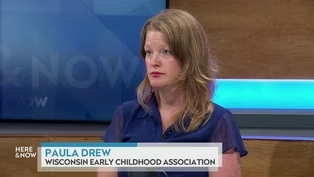
>> If you have children and child care programs, expect tuition to go up and availability to go down.
That's because temporary Covid era funding to help providers keep costs down and retain staff is set to expire at the end of June.
The child care bridge payments of $110 million took up after more robust federal stabilization funding ended results from a new report and survey from the Wisconsin Early Childhood Association show that three quarters of providers across the state said they'll need to raise tuition, and a quarter of providers said they're likely to close.
We're joined now by Paula Drew, director of early childhood education policy and research for the association, and thanks very much for being here.
>> Thanks for having me.
>> So with costs up elsewhere for food and fuel, how are working families who depend on childcare likely to respond to these tuition hikes?
>> I think families around the state right now are sitting around tables like this, asking themselves, does it make sense for one of us to keep working?
If it makes sense, should we work part time instead of sending our child to a licensed child care program down the street?
Perhaps we should entertain a grandparent, a neighbor, because the cost of care is just becoming unaffordable to the point where those who have the means to access it will, and those that don't simply will be sort of priced out of the market.
>> Because what kind of tuition increases could we be talking about in general?
>> So 75% of child care providers at answer this question, and they said, we will have to raise our tuition rates at least $25 per week.
And so that's, you know, between 2000 and $3000 per year.
>> It's already pretty expensive.
>> It's already, I think, at the point where some families can no longer afford it.
>> So how meaningful was the original "Child Care Counts" program that used federal emergency Covid funds to stabilize the industry?
>> The original "Child Care Counts" program was very meaningful, and child care providers have been on record over and over and over, stating, this is the first time I've ever been able to start a retirement account.
For our early educators, we are actually accessing health insurance for the very first time.
Our early educators are earning a wage in which they only have to work one job.
It also kept tuition rates affordable for parents.
>> How much of Wisconsin providers gotten from both programs?
>> Hundreds of millions of dollars.
>> And so going from hundreds of millions of dollars over the past six years to nothing, it's easy to see why your survey results show that they will have to make some of these very difficult choices.
>> That's right.
For years on end, childcare providers have been depending on this funding to meet the gap between what parents can pay and what it actually costs to provide high quality childcare.
And without those funds, most people within the field are asking these same, very hard questions that parents are should we close?
Should we let go of some staff?
Should we lessen the hours of operations that we have, stop providing food, stop providing bussing, you know, cutting costs, right?
Both parents and providers are are trying to figure out how they can make the math work.
is my understanding is that it's already difficult, but how stunning is it that a quarter of providers might have to close their operations?
>> It's very dramatic.
And I think when we dig into the numbers and we think about 25% of providers now, 25% of group providers, that's a really significant amount of child care seats available in the state.
Right?
So family child care providers can serve up to eight children at a time, but group programs can serve hundreds of children.
So we're thinking about, you know, when you just think 25%, it's not just like across the board in terms of how many seats we have.
And I think that's going to be really stark.
And I also would estimate that that that number is likely going to be larger than it was when the research was done.
>> Is there any prospect that the state would replicate this funding?
>> I would love to see this program be codified into law.
I think we have seen examples from all over the country states, red, blue, purple states making significant investments in the childcare sector and seeing really big returns on that investment.
Anything's possible when you prioritize it.
And yes, we would love to see this program continue it.
It had all the components that I think are needed to hold together.
This market.
>> Is, for some policymakers, does that kind of funding smack of an entitlement?
>> It can and I think it it's because the childcare sector itself is is made up of for profit, nonprofit family child care providers operating out of their homes, you know, large group programs.
It's hard to sort of wrap your mind around it versus like a K-12 system.
You need a teaching license, you need a certain amount of education to meet the teaching license.
That doesn't mean that that's not also required in early care and education, but it's not what you think about because of the the fabric of these providers in the state, you know, look different.
But I would argue a, you know, a wage and career ladder for early care and education based on experience.
And their own education is the same.
That is in K-12 schools, right?
In which is public is publicly funded.
We see that as a public good.
What's happening over here is the same exact thing, but it's entirely funded mostly by parent fees.
>> All right.
Well, Paula Drew, thanks very much.
>> Thank you for having me.
>> For more on this and other issues facing Wisconsin, visit our website at PBS Wisconsin Education Vigue and then click on the news tab.
That's our program for tonight.
I'm Frederica Freyberg.
Have a good weekend.
>> Funding for "Here& Now" is provided by the Focus Fund for Journalism and friends of PBS Wisconsin.
 New
NewThe Continuing Closure of Rural Schools Around Wisconsin
Video has Closed Captions
Clip: S2400 Ep2447 | 7m 44s | Rural school districts face decisions over closing facilities or shutting down altogether. (7m 44s)
 New
NewDon Millis on Administering Wisconsin's Elections in 2026
Video has Closed Captions
Clip: S2400 Ep2447 | 5m 51s | Don Millis on a FBI probe into the 2020 vote and a proposed new mail-in ballot rule. (5m 51s)
 New
NewHere & Now opening for June 5, 2026
Video has Closed Captions
Clip: S2400 Ep2447 | 1m 7s | The introduction to the June 5, 2026 episode of Here & Now. (1m 7s)
 New
NewInside Wisconsin Politics: Trump's Chippewa County Visit
Video has Closed Captions
Clip: S2400 Ep2447 | 2m 24s | Inside Wisconsin Politics on President Trump's visit to Chippewa County. (2m 24s)
 New
NewPaula Drew on Child Care Bridge Payments Ending in Wisconsin
Video has Closed Captions
Clip: S2400 Ep2447 | 6m 7s | Paula Drew on anticipated impacts of the expiration of Child Care Bridge Payments. (6m 7s)
 New
NewTrump Visits Wisconsin to Tout His Agriculture Tax Breaks
Video has Closed Captions
Clip: S2400 Ep2447 | 2m 44s | President Donald Trump visited Chippewa County to promote his agricultural policies. (2m 44s)
Providing Support for PBS.org
Learn Moreabout PBS online sponsorship New Episode
- News and Public Affairs

Top journalists deliver compelling original analysis of the hour's headlines.

- News and Public Affairs

FRONTLINE is investigative journalism that questions, explains and changes our world.
 New Episode
 New Episode
 New Episode
 New Episode


 New Episode
 New Episode
 New Episode
Support for PBS provided by:
Here and Now is a local public television program presented by PBS Wisconsin