
Iowa Western Family Farm
Clip: 6/29/2026 | 6m 34sVideo has Closed Captions
An Iowa farm thrives as one of the state’s few Black-owned farms.
An Iowa farm thrives despite the untimely loss of the family patriarch, carrying on his legacy as one of the state’s few Black-owned farms.
Problems playing video? | Closed Captioning Feedback
Problems playing video? | Closed Captioning Feedback
America's Heartland is presented by your local public television station.
Funding for America’s Heartland is provided by US Soy, Sustainable Agriculture Research and Education, Rural Development Partners, and a Specialty Crop Grant from the California Department of Food and Agriculture.
Iowa Western Family Farm
Clip: 6/29/2026 | 6m 34sVideo has Closed Captions
An Iowa farm thrives despite the untimely loss of the family patriarch, carrying on his legacy as one of the state’s few Black-owned farms.
Problems playing video? | Closed Captioning Feedback
Where to Watch America's Heartland
America's Heartland is available to stream on pbs.org and the PBS app.
Providing Support for PBS.org
Learn Moreabout PBS online sponsorship(mellow orchestral music) - A lot of people go to the cemetery to honor their loved ones, I honor my father here by doing the farming.
- [Narrator] The Western family is hard at work on their Waterloo, Iowa, farm today, and things are looking good; nice weather, the equipment is running smoothly, and most importantly, the family is together.
- On a farm, there's always different jobs to do, it's not just driving a combine, it's filling up a tire, you know, running to pick up a piece of equipment.
- [Narrator] Today, Todd Western III, along with his brothers, Christopher and Adam, divvy up the duties, while matriarch and farm CEO, Barbara Western, keeps a close eye on things.
The Western siblings were thrust into farm management in 2008 when a bicycle accident took the life of their father, Todd Western Jr.
- Left a huge hole in the family, left a huge hole in the family.
It was nine months from retirement and a week before his 65th birthday, it just wasn't fair that he went like that.
But, you know, you have to step up and make things happen, and we did that.
- He'd be smiling.
I don't know if he'd let me drive the combine, though.
(brothers laughing) Yeah, it was hard to get the combine off from underneath him.
- [Narrator] Now, with each pass of the combine, the next generation carries their father's farming legacy forward.
- Dad always said, "You've done good, boy."
(chuckles) - [Narrator] And legacy is the right word.
In addition to farming, Todd Western Jr.
was the first Black supervisor for farm equipment manufacturer John Deere back in 1968.
And their mother, Barbara... - My mom was the first Black cheerleader at a school in Chicago.
She's one of the first to go to New York to get on a scholarship to sing opera in New York.
So my parents are trailblazers from that standpoint.
- I came up here as a little boy coming up as a child, riding in the back of the tractor, and just being a part of it has always been something cool, something special, and in a way to kind of honor his memory and keep the tradition going.
It was here before me and it'll be here long after I'm gone.
- At the end of the day, what are we really trying to achieve?
We're trying to honor mother and father.
- [Narrator] Today, the sustainability of their farm isn't just measured in dollars and cents.
The Westerns are focused on environmental practices that require less chemicals added to the soil.
- As we evolve as a society, we realize that, you know, the ground can only take so much.
And like I tell people, mother nature can do her own job, we don't need to help her, we don't need to speed it up, but as a society, we want things bigger, better, greener for more profit.
But we have to just take a step back, say "If we continue to do this, then what's gonna happen to the ground?"
- Our human nature is to control everything, and we over-control in most cases.
But this time they're listening and letting the Earth regenerate itself, and it's better.
- [Narrator] Todd Western says increasing weather extremes have created serious challenges; unpredictable droughts and heavy rains negatively impact their bottom line.
As farmers, Todd says, they're good at adapting and learning new practices to mitigate the impacts of these extreme weather events.
In 2008, the family began using no-till and cover cropping practices on their farm.
Todd says, after about eight years, the impacts of these practices became fully realized, naturally reducing weeds, lessening the need for chemicals, and enriching their soil.
Healthier soil can better retain water, allowing crops to withstand droughts or absorb heavy rain.
The family is also converting some of their less productive ground to grasslands with the aim of attracting pollinators and improving soil quality using fewer inputs.
And they recently enrolled in a carbon capture credit plan that would expand these farming practices.
Farmers can earn credits and compensation through such plans by removing carbon dioxide from the atmosphere or improving soil health.
- That's my job and our family's job to make sure that we're good stewards of the land, to make sure that we're setting this up for the next 160 years.
- [Narrator] The Western family farm has roots in one of America's darkest chapters.
In the late 1800s when the Civil War was raging, the State of Iowa was a strong union supporter.
Members of the Western family escaped slavery and purchased farmland in southeastern Iowa.
Generation after generation, the Western family has worked the Iowa soil.
In addition to learning farming practices from Todd Western Jr, the Western brothers learned lessons in how to handle the challenges that come with being a Black farmer in a state that's 90% white.
- I remember one time we wanted to buy a semi, and the guy wouldn't let him get in the semi to test drive or to look at it.
- They observed a Black farmer granddad, you know?
What I did teach them that they were going to be proud, young Black men.
- You know, in 1944, you know, 12 to 14% of the farmers were Black, today, there's less than 1.4%.
And then that started to hit me that we represent part of that 1.4%.
- [Narrator] Todd says they were taught not to dwell on slights, instead to lean into using their voices to make change.
He's founded an organization called Iowa Farmers of Color.
- So the number one goal is to network, build a community, number two is to build an access bridge to state agencies, so that state agencies know that there are farmers of color in the state of Iowa, and that we need the same service and the same assistance.
- [Narrator] 160 years of harvest, opportunities, heartaches, and a family taking pride in their legacy, looking to the future.
- So a lot of things happened that could have destroyed our family back then, but we persevered through all the years.
So if you look at it from that perspective, I owe it to them to keep it going and to honor them.
(intriguing orchestral music)
Video has Closed Captions
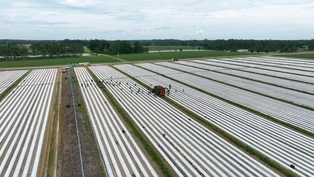
A Georgia farm keeps the produce coming year-round by planting and harvesting in different locations (4m 35s)
Video has Closed Captions
Soybeans may soon be part of the asphalt beneath you. (5m 39s)
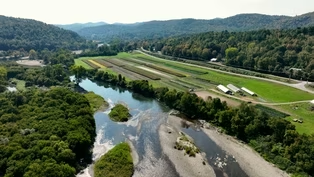
Vermont Farming Climate Challenges
Video has Closed Captions
A Vermont couple finds new ways to better protect their land from drought and floods. (5m 35s)
Providing Support for PBS.org
Learn Moreabout PBS online sponsorship
- Food
Christopher Kimball’s Milk Street Television
Transform home cooking with the editors of Christopher Kimball’s Milk Street Magazine.




Support for PBS provided by:
America's Heartland is presented by your local public television station.
Funding for America’s Heartland is provided by US Soy, Sustainable Agriculture Research and Education, Rural Development Partners, and a Specialty Crop Grant from the California Department of Food and Agriculture.