
An Iowa Farm Family's Story
6/29/2026 | 26m 30sVideo has Closed Captions
Iowa farm family thrives. Vermont farm adjusts to extreme weather. Soybeans used for road asphalt.
An Iowa farm thrives despite the untimely loss of the family patriarch on his legacy as one of the state’s few Black-owned farms. A Vermont couple finds new ways to better protect their land from drought and floods. A Georgia farm keeps the produce coming year-round by planting and harvesting in three different locations. Soybeans may soon be part of the asphalt beneath you.
Problems playing video? | Closed Captioning Feedback
Problems playing video? | Closed Captioning Feedback
America's Heartland is presented by your local public television station.
Funding for America’s Heartland is provided by US Soy, Sustainable Agriculture Research and Education, Rural Development Partners, and a Specialty Crop Grant from the California Department of Food and Agriculture.
An Iowa Farm Family's Story
6/29/2026 | 26m 30sVideo has Closed Captions
An Iowa farm thrives despite the untimely loss of the family patriarch on his legacy as one of the state’s few Black-owned farms. A Vermont couple finds new ways to better protect their land from drought and floods. A Georgia farm keeps the produce coming year-round by planting and harvesting in three different locations. Soybeans may soon be part of the asphalt beneath you.
Problems playing video? | Closed Captioning Feedback
Where to Watch America's Heartland
America's Heartland is available to stream on pbs.org and the PBS app.
Providing Support for PBS.org
Learn Moreabout PBS online sponsorship- [Narrator] Coming up on "America's Heartland," how America's farmers and ranchers survive and thrive by learning to adapt and innovate.
We'll travel to Iowa to meet one of the first Black families to establish a farm here after the Civil War.
Today, despite personal tragedy, they remain dedicated to a legacy of sustainability and success.
A family buys a legacy farm in Vermont and discovers it has to find new ways to deal with unprecedented challenges, like droughts and flooding.
We'll head South to Georgia where this farm grows vegetables year-round from three locations to keep the harvests coming despite unpredictable weather.
And some remarkable new products are being made from American soybeans, including the asphalt being used on more of our highways and byways.
It's all next on "America's Heartland."
"America's Heartland" is made possible by... - [Announcer] Sustainable Agriculture Research & Education.
SARE is a USDA grants program for farmers, researchers, and educators.
Since 1988, SARE grantees have used their own innovative ideas to improve profitability, stewardship, and quality of life on farms and ranches across the US.
More information at sare.org.
U.S.
Soy, powered by the innovation of the American soybean industry and a commitment to the sustainability of the soybeans grown by our farming families who invest through checkoff dollars.
More information at unitedsoybean.org.
♪ You can see it in the eyes of every woman and man ♪ ♪ In America's Heartland livin' close to the land ♪ ♪ There's a love for the country and a pride in the brand ♪ ♪ In America's Heartland living close ♪ ♪ Close to the land (country orchestral music) (air whooshing) (mellow orchestral music) - A lot of people go to the cemetery to honor their loved ones, I honor my father here by doing the farming.
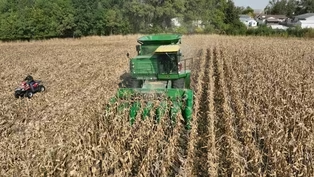
- [Narrator] The Western family is hard at work on their Waterloo, Iowa, farm today, and things are looking good; nice weather, the equipment is running smoothly, and most importantly, the family is together.
- On a farm, there's always different jobs to do, it's not just driving a combine, it's filling up a tire, you know, running to pick up a piece of equipment.
- [Narrator] Today, Todd Western III, along with his brothers, Christopher and Adam, divvy up the duties, while matriarch and farm CEO, Barbara Western, keeps a close eye on things.
The Western siblings were thrust into farm management in 2008 when a bicycle accident took the life of their father, Todd Western Jr.
- Left a huge hole in the family, left a huge hole in the family.
It was nine months from retirement and a week before his 65th birthday, it just wasn't fair that he went like that.
But, you know, you have to step up and make things happen, and we did that.
- He'd be smiling.
I don't know if he'd let me drive the combine, though.
(brothers laughing) Yeah, it was hard to get the combine off from underneath him.
- [Narrator] Now, with each pass of the combine, the next generation carries their father's farming legacy forward.
- Dad always said, "You've done good, boy."
(chuckles) - [Narrator] And legacy is the right word.
In addition to farming, Todd Western Jr.
was the first Black supervisor for farm equipment manufacturer John Deere back in 1968.
And their mother, Barbara... - My mom was the first Black cheerleader at a school in Chicago.
She's one of the first to go to New York to get on a scholarship to sing opera in New York.
So my parents are trailblazers from that standpoint.
- I came up here as a little boy coming up as a child, riding in the back of the tractor, and just being a part of it has always been something cool, something special, and in a way to kind of honor his memory and keep the tradition going.
It was here before me and it'll be here long after I'm gone.
- At the end of the day, what are we really trying to achieve?
We're trying to honor mother and father.
- [Narrator] Today, the sustainability of their farm isn't just measured in dollars and cents.
The Westerns are focused on environmental practices that require less chemicals added to the soil.
- As we evolve as a society, we realize that, you know, the ground can only take so much.
And like I tell people, mother nature can do her own job, we don't need to help her, we don't need to speed it up, but as a society, we want things bigger, better, greener for more profit.
But we have to just take a step back, say "If we continue to do this, then what's gonna happen to the ground?"
- Our human nature is to control everything, and we over-control in most cases.
But this time they're listening and letting the Earth regenerate itself, and it's better.
- [Narrator] Todd Western says increasing weather extremes have created serious challenges; unpredictable droughts and heavy rains negatively impact their bottom line.
As farmers, Todd says, they're good at adapting and learning new practices to mitigate the impacts of these extreme weather events.
In 2008, the family began using no-till and cover cropping practices on their farm.
Todd says, after about eight years, the impacts of these practices became fully realized, naturally reducing weeds, lessening the need for chemicals, and enriching their soil.
Healthier soil can better retain water, allowing crops to withstand droughts or absorb heavy rain.
The family is also converting some of their less productive ground to grasslands with the aim of attracting pollinators and improving soil quality using fewer inputs.
And they recently enrolled in a carbon capture credit plan that would expand these farming practices.
Farmers can earn credits and compensation through such plans by removing carbon dioxide from the atmosphere or improving soil health.
- That's my job and our family's job to make sure that we're good stewards of the land, to make sure that we're setting this up for the next 160 years.
- [Narrator] The Western family farm has roots in one of America's darkest chapters.
In the late 1800s when the Civil War was raging, the State of Iowa was a strong union supporter.
Members of the Western family escaped slavery and purchased farmland in southeastern Iowa.
Generation after generation, the Western family has worked the Iowa soil.
In addition to learning farming practices from Todd Western Jr, the Western brothers learned lessons in how to handle the challenges that come with being a Black farmer in a state that's 90% white.
- I remember one time we wanted to buy a semi, and the guy wouldn't let him get in the semi to test drive or to look at it.
- They observed a Black farmer granddad, you know?
What I did teach them that they were going to be proud, young Black men.
- You know, in 1944, you know, 12 to 14% of the farmers were Black, today, there's less than 1.4%.
And then that started to hit me that we represent part of that 1.4%.
- [Narrator] Todd says they were taught not to dwell on slights, instead to lean into using their voices to make change.
He's founded an organization called Iowa Farmers of Color.
- So the number one goal is to network, build a community, number two is to build an access bridge to state agencies, so that state agencies know that there are farmers of color in the state of Iowa, and that we need the same service and the same assistance.
- [Narrator] 160 years of harvest, opportunities, heartaches, and a family taking pride in their legacy, looking to the future.
- So a lot of things happened that could have destroyed our family back then, but we persevered through all the years.
So if you look at it from that perspective, I owe it to them to keep it going and to honor them.
(intriguing orchestral music) (lively upbeat music) (vehicles whooshing) - [Narrator] Every day, millions of people drive, walk, and bicycle millions of miles on America's highways and byways.
Virtually, all of them travel on asphalt made with petroleum-based products.
(attendees chattering) (lively upbeat music) But that may be about to change, and in a big way.
And it's starting at places like the Farm Progress Show in Boone, Iowa.
Inside this 42,000-square foot tent are over 100 ag exhibitors showing off their products and services.
And the thousands of people wandering through here are walking on asphalt made partly from soybean oil.
- I mean, man, if that doesn't say sustainable, I don't know what does.
- [Narrator] Robb Ewoldt is an Iowa soybean farmer and member of both the United Soybean Board and the Iowa Soybean Association.
Through the USB's National Checkoff Program, these organizations partnered with Iowa State University to develop soy asphalt.
The shared goal: a more sustainable, environmentally-friendly alternative to traditional roadways made entirely with petroleum products.
- I mean, that should be, "Wow, we can grow oil, harvest it, process it, and have a great product, like what we see here at the show, and what we're seeing on roads throughout the country."
- [Narrator] The concept of soy-based asphalt has already been around for more than a decade, but it steadily evolved and improved thanks to ongoing research and testing at other places around the ag expo and elsewhere, like this roadway in Alabama.
The soy component is made from soybeans high in something called high oleic oil.
That oil helps create a kind of rubber product that acts as a binder to help stabilize the asphalt as it's mixed with traditional petroleum ingredients.
- It's safer for handling and production and it's got longer storage time and stability, and it's turnkey into the current operations.
So it really just makes a lot of sense.
- [Narrator] Early research also suggests the soy asphalt lasts longer than traditional asphalt, and, says Grant Kimberley of the Iowa Soybean Association, it's more eco-friendly.
- A lot of the asphalt roadways across America are gonna be needing to be repaved, there's gonna be new roads, and this material is just perfect for that kind of thing, 'cause a lot of the government entities are looking at ways to reduce the carbon emissions and improve the shelf life of these materials and also ultimately make it better for the environment.
- But these soybean oil products, they're about 10 times more effective than those petroleum-based products in making those really brittle, heavily-processed asphalts back into usable paving materials.
So, you know, that's just the US market, and there are other international markets where, you know, they're facing the same challenges, a lot of them are big importers of soy and soybean oil.
- We can go electric with our vehicles, we can go wind with our houses, what have you, but you're gonna need some sort of oil to make these roads stick together; and this is a renewable way, a renewable product, instead of having to drill for it.
- [Narrator] And renewable isn't just a hopeful word for our planet, it represents opportunity for America's soybean growers.
It took more than 285 bushels of soybeans just to make the asphalt inside this tent, multiply that by thousands of miles of new and repaved roadways.
- We think about how many bushels of soybeans that can utilize, and what that means to farmers' bottom lines, the opportunity to grow soybeans at a better price, ultimately, where they can make a good living for their families and then provide a service and a product that's good for America and the consumers of America.
- I think that the potential is, what, somewhere in the neighborhood of approaching about a million tons of soybean oil per month.
- [Narrator] Much of this research and innovation has come about thanks to soybean farmers themselves.
By investing farmer dollars through the Checkoff Program, they're also investing in new soy products and new and expanded markets for their crops.
There's already more than a million acres of high oleic soybeans planted across the US designed for use in products like soy asphalt.
- I can't state enough how the farmers paid for this type of investment so that all can benefit.
I think that's an important fact that the consumer needs to understand.
- Continued investment in industrial uses for soy is just so critical.
There is so much value in the chemistry of vegetable fat molecules that soy just produces so well, and we have so much infrastructure in place to produce it at scale.
I really think there's a lot more potential for what we can get out of soy as a building block for a lot of the materials that we use and take for granted every day.
- [Narrator] Better product, longer lasting, lower cost; bottom line say these soybean folks is another example of the many ways they're working to improve the environment, and showing consumers their commitment to making the best and safest products, whether it's food, feed, or oil.
- I think the more they understand all these extra things that are in their everyday life, as they walk upon their their house, they will have a greater appreciation for agriculture and production ag in the United States.
(bright mellow country orchestral music) - [Narrator] Still ahead on "America's Heartland," the weather is changing throughout America's heartland, including the Deep South and even New England.
See how this Georgia family is using new planting and harvesting strategies to keep produce coming to our tables year-round.
But, first, discover how this Vermont family is making big changes to their farm to deal with the prospect of both drought and flooding.
(bright mellow country music) - [Narrator] In the heart of Vermont's White River Valley, you'll find the unincorporated village of South Royalton.
Among its 500 residents are Ashley Loehr and Antoine Guerlain who purchased Hurricane Flats farm in 2022.
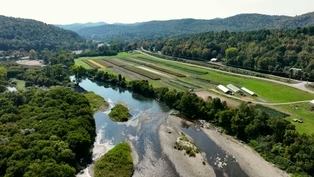
It's 37 acres of farmland that stretches along the river's edge, ground that brings both opportunity and uncertainty.
- We sell our produce through a farm stand here on the farm.
We do a farmer's market in Norwich, Vermont, on Saturdays, and then we sell wholesale.
- South Royalton is a close-knit farming community that's resilient in the face of a great deal of change they've seen in recent years.
Changes to the weather, threats to their crops, even changes to the farmers themselves.
Geo Honigford used to work this land, growing popcorn and hay for nearly three decades before selling it to Ashley and Antoine.
Geo says the increasing unpredictability of the weather was a key factor in his decision.
- We're getting this wild extremes of weather much faster than anybody else.
Precipitation has increased, snowfall has decreased, - Drought, floods, hail, really extremely heavy rain, extreme winds, all those things are happening all the time, and could happen at any minute.
- Geo figured that younger farmers would have the passion and creativity to work with these evolving challenges.
- They're great young people, they're great farmers, they got a great family, they've been great community members.
I couldn't be happier that they took over the farm.
- Poppy, we're almost there.
Can we pick some vegetables?
- Yeah, we should.
- [Narrator] Ashley and Antoine and their two kids wasted no time getting to know the community, growing certified organic popcorn, produce, and hay, and working on ways to better prepare for the weather changes that they faced almost immediately.
- Well, our first of the three years we've been here, the first year was droughty actually, three years ago.
- Extremely droughty.
- Extremely droughty.
- Yeah.
- [Narrator] Ashley says New England was once considered a relatively stable location for farming; but she says it's now often at the forefront of weather disasters, from the extreme drought they faced in their early days of farming, to the extreme flooding they experienced in 2023.
- So that flood was weird, 'cause it wasn't a hurricane, it wasn't a storm, it wasn't a tropical storm, it was just a rainy day, after many, many rainy days.
So the river was already high, and then it started raining in the morning, and then it kept raining, and then the water came up out of the river and into the fields.
- [Narrator] And once flood water touches the edible portion of a crop, it can no longer be sold to the public.
Ashley and Antoine lost 75% of their projected gross income.
For farmers in the White River Valley, the flood brought back painful memories of Hurricane Irene, which devastated the region in 2011.
That was during Geo's time as owner.
- It just hits you, you work so hard to get that, and then just to watch it all get ruined; I mean thousands of pounds of onions, thousands of pounds of sweet potatoes, you just turn 'em into the ground, 'cause you can't sell 'em, and it breaks your soul.
- [Narrator] But there were some key lessons farmers took from Irene, and the tumultuous years that came after.
- One of the things we did was reorganize our fields, so that our units of management are narrower and longer, so that we can do strip cropping.
- [Narrator] During severe weather events, strip cropping allows a crop like knee-high corn to act as a buffer to neighboring crops that are in different growth stages.
- You know, if things are at different growing stages, different life stages, different stages of maturity; when you got a flood, you have a little bit more flexibility in terms of what might make it and what might not, and some things can protect other things.
- [Narrator] Now they plant high-value crops closer together in the areas less likely to flood, and grow more flood-resilient crops that require less labor.
They also increased crop diversity by planting a mix of long season crops and short cycle crops that can fill the income gap caused by extreme weather crop loss.
After Hurricane Irene, Geo worked with a non-profit group called White River Partnership to plant a buffer of trees and shrubs along the river - In a flood situation, they act as speed bumps, they kind of slow the water down.
And if you slow the water down, you take the energy and your power out of the stream.
- Not to stop the water from coming in, 'cause you really can't do that, but it makes it so that less stuff washes in when the water comes in, and we really reaped the benefits of that.
- [Narrator] Ashley and Antoine are now working with the White River Partnership to grow about a thousand tiny trees that can be transplanted to farms throughout the region.
- One thing that we're really lucky for is that a lot of people care about this place and this farm, and it's been a part of their lives, and because I think there's a lot of people that want food to continue to be grown here.
- You have to sort of have an adaptive attitude, like, I think there's been moments where we've thought like- - Yeah.
- "Oh, should we not be farming on a floodplain?
You know, should we be farming on a hilltop?"
- Then you have a year like this and this beautiful soil, and you think, "Ah, one more year, let's try it."
(Ashley chuckles) - Well, yeah, yeah, yeah, yeah.
- [Narrator] Farming has never been an easy path, but here in the White River Valley, farmers face each challenge the way they always have: by adapting, innovating, practicing sustainability, and leaning on each other.
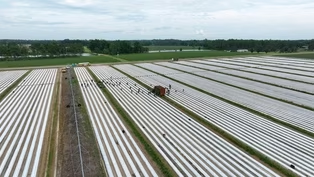
(child laughing) (mellow orchestral music) - [Narrator] These fields in Norman Park, Georgia, are covered in vegetables, growing in the summer sun at Southern Valley Fruit & Vegetable, a cornerstone of American agriculture with deep roots in the Deep South.
(mellow orchestral music) Kent Hamilton is the President of Southern Valley, his daughter, Courtney Hamilton Griffin, is Director of Operational Support and part-owner.
Side by side, Courtney and Kent work every single day, cultivating not only fresh, high-quality produce, but a legacy of sustainability and innovation.
- We are doing something that's been done for generations, and we want to continue that.
Is it harder today than it's ever been?
Absolutely.
Is it getting easier?
No, not really.
But we are doing the basics of human life.
- [Narrator] But growing those basics of life for consumers across America is anything but simple in the southeast.
Extreme heat along with intensifying hurricane seasons turns a difficult job into an unpredictable journey.
- You can do everything right, the bees can be working, they can be pollinating the field, you can have the perfect fertilizer mix and everything else, and then all of a sudden a storm pops up, a hurricane hits your field, and destroys it.
And I mean, you can't change that because mother nature drives everything we do.
- [Narrator] The first seeds of Southern Valley were planted in 1987, and since then, a lot has changed.
Adapting to changing weather patterns also means spreading out.
Southern Valley grows vegetables in the heat of summer in Eastern Tennessee, and during the winter in Mexico's Yucatan Peninsula.
- There's a lot of planning that goes into what we do, a lot of projecting, you know, how much product are we gonna need, when are we gonna need it?
And, two, we have to project what the weather's gonna do; if the weather's cooler than what it normally is, then the crop don't come off as quite as soon as what we have projected.
(intriguing orchestral music) - [Narrator] On this late July day, it's hot and humid, and just three weeks earlier, these beautiful row crops were sitting directly in the path of a major hurricane.
This time, farmers got lucky, but the threat from the increasing heat in the tropics is nothing new to farmers here in Southeastern Georgia.
- So a hurricane can come through, if it comes through in September, October, when we're right in the heart of our production, it can be devastating, have devastating effects on our crop.
- [Narrator] It's also harvest time, and it's hopping.
These vegetables coming in from extreme heat need immediate attention to stay fresh.
This state-of-the-art packing plant is where vegetables are quickly cooled, cleaned, packed, and shipped directly to some of the biggest produce suppliers in the country.
But their biggest concern is keeping workers safe during dangerously hot days; something Kent and Courtney monitor in the field every single day, shifting outside hours to protect the workers.
During extreme heat, harvest happens early in the morning, protecting the workers from the scorching sun.
- We've had some hot days, but, you know, we start planting late in the afternoon when the sun's already starting to go down, and it's starting to cool off.
- [Narrator] On this day, there's a window just before dusk, there's a break in the heat with rain showers on the way, providing perfect conditions for workers to get these bell pepper plants in the ground.
- If you treat people with kindness and love and respect, they're going to give you that in return.
- [Narrator] With roots deep in the soil, this family hopes to show that agriculture can nourish the soul and connect the community while helping preserve the planet one table at a time.
- Thankfully, the way the climate is, the way the sun moves north and south through the year, there's somewhere in the world that we can produce food on a year-round basis.
- [Narrator] That's it for this edition of "America's Heartland."
For more stories, full episodes, and recipes, visit americasheartland.org, or connect with us on Facebook.
♪ You can see it in the eyes of every woman and man ♪ ♪ In America's Heartland livin' close to the land ♪ ♪ There's a love for the country and a pride in the brand ♪ ♪ In America's Heartland livin' close ♪ ♪ Close to the land - [Narrator] "America's Heartland" is made possible by... - Sustainable agriculture Research & Education.
SARE is a USDA grants program for farmers, researchers, and educators.
Since 1988, SARE grantees have used their own innovative ideas to improve profitability, stewardship, and quality of life on farms and ranches across the US.
More information at sare.org.
U.S.
Soy, powered by the innovation of the American soybean industry and a commitment to the sustainability of the soybeans grown by our farming families who invest through checkoff dollars.
More information at unitedsoybean.org.
Video has Closed Captions
A Georgia farm keeps the produce coming year-round by planting and harvesting in different locations (4m 35s)
Video has Closed Captions
An Iowa farm thrives as one of the state’s few Black-owned farms. (6m 34s)
Video has Closed Captions
Soybeans may soon be part of the asphalt beneath you. (5m 39s)
Vermont Farming Climate Challenges
Video has Closed Captions
A Vermont couple finds new ways to better protect their land from drought and floods. (5m 35s)
Providing Support for PBS.org
Learn Moreabout PBS online sponsorship

- Food
Christopher Kimball’s Milk Street Television
Transform home cooking with the editors of Christopher Kimball’s Milk Street Magazine.









Support for PBS provided by:
America's Heartland is presented by your local public television station.
Funding for America’s Heartland is provided by US Soy, Sustainable Agriculture Research and Education, Rural Development Partners, and a Specialty Crop Grant from the California Department of Food and Agriculture.